The Corporate Sustainability Reporting Directive (CSRD) represents a turning point for the transparency of corporate sustainability reports. Companies are encouraged to disclose not only their financial but also their environmental and social impacts. A key component of this is the double Materiality Assessment.
Key Takeaways
The CSRD requires companies to undertake a double Materiality Assessment. Implementation can be achieved in 4 steps:
- Understand context: Analyze business model, value chain, stakeholders, and regulatory frameworks.
- Identify IROs: Systematically identify material Impacts, Risks & Opportunities.
- Assess IROs: Determine financial and impact materiality based on severity, scope, likelihood, and relevance.
- Prepare report: Transparently disclose results, methods, and stakeholder engagement in the sustainability report.
Tools, templates, and specialized software like Materiality Master facilitate the process and ensure auditability.
What is a Double Materiality Assessment?
A double Materiality Assessment (also called materiality analysis) is a process in which companies explicitly identify and assess the topics that are material to their business operations and stakeholders in terms of Environment, Social, and Governance (ESG – Environmental, Social, and Governance) This helps companies to set the right priorities and use resources efficiently.
The so-called double Materiality Assessment is a central component of CSRD sustainability reports that are compliant with the ESRS. Such a Materiality Assessment is also required in the Global Reporting Initiative (GRI) guidelines. It is a good basis for meeting the requirements of the ESRS as well. Companies should not only aim to meet legal requirements. Rather, it provides valuable information for investors, customers, and other stakeholders and creates insights that can serve as decision-making aids.
Is there a Difference between a Materiality Assessment and Double Materiality?
The difference between a traditional Materiality Assessment and the concept of double materiality lies in the perspective and scope of assessing sustainability topics.
Traditional Materiality Assessment
- The traditional Materiality Assessment focuses on identifying and assessing topics that are material to the company and its stakeholders.
- The focus is on how these issues influence business activities and what impact they have on the company’s long-term performance and sustainability.
- The assessment is usually from the perspective of the company and its immediate interests, such as risk management, reputation management, financial impact and compliance.
Double Materiality Assesment
- The concept of double materiality expands this approach by considering not only the importance of an issue for the company, but also the company’s impact on the environment and society.
- This involves two dimensions:
- Internal materiality or financial materiality (outside-in): the significance of a sustainability issue for the company (financial impact, risks and opportunities) and
- External materiality or impact materiality (inside-out): The impact of the company in this area on the outside world (such as the environment, society and the economy).
What does IRO mean in the context of CSRD?
In the context of the Corporate Sustainability Reporting Directive, “IRO” stands for “Impacts, Risks, and Opportunities”. Determining material information on a company’s sustainability impacts, risks, and opportunities is a central component of the Materiality Assessment and thus also of the CSRD.
What are the 4 Steps of a Double Materiality Assessment?
1) Understanding the context
The first step is to classify the company context. The following measures can be implemented:
a) Create an overview of business activities and relationships:
- Analysis of the business plan, strategy, financial reports and other relevant information.
- Overview of products/services and geographical locations.
- Mapping of business relationships and the upstream and downstream value chain.
b) Consider further contextual information:
- Analysis of the legal and regulatory framework.
- Reviewing media reports, industry benchmarks, sustainability trends and scientific articles is relevant in order not to neglect silent stakeholders. For example, unlike other stakeholders, nature as a silent stakeholder cannot voice its concerns. Therefore, data from scientific sources can give nature a voice.
c) Develop an understanding for affected stakeholders:
- Identification and analysis of existing stakeholders and their views and interests.
- Mapping the affected stakeholders to the business activities. Separate groups of affected stakeholders can be identified for each activity, product or service, which must be prioritized for a specific sustainability issue.
Stakeholder engagement serves to identify and assess the material IROs. This can help with the assessment of relevance, probability and time horizon and also ensure the completeness of the material topics identified.
2) Identification of actual and potential IROs
- The list of sustainability topics in ESRS 1 (paragraph AR16) should serve as an aid during the process and ensure completeness.
- In addition, there are aspects that are not included in ESRS 1 but may nevertheless be material for the company.
- Until the sector-specific standards are issued, such aspects must be determined and evaluated on a company-specific basis.
- The list of ESRS data points published by EFRAG is not intended as a checklist for identifying material sustainability topics or IROs, but provides a useful and more detailed overview of the ESRS standards. EFRAG also offers further CSRD guidance.
- For each IRO identified, it must be stated whether it relates to the company’s own operations, the upstream or downstream value chain and the corresponding time horizon (short, medium and long term).
- Companies can group the identified IROs into categories. In doing so, they should adapt the designations and terminology to those of ESRS 1.
3) Evaluation and definition of the main IROs
In step 3, the extensive ‘long list’ of IROs is analyzed in more detail. Criteria are applied to determine the material actual and potential impacts as well as the material risks and opportunities. This then forms the basis for determining the material information that must be disclosed. Qualitative and quantitative thresholds for determining whether an IRO is material or not can be found in ESRS 1 and 2.
Impact Materiality Assessment
To determine the materiality of the impacts, the impacts from step 2 are assessed according to the extent or severity of the (potential) impacts. The following information should be recorded depending on the type of impact:
- Actual negative impact: The magnitude, extent and irreversible nature (irretrievability) of the impact.
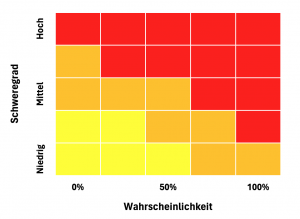
- Potential negative impacts: In addition, the probability and corresponding time horizon of occurrence should be assessed.
- Actual positive impact: The scale and scope of the impact.
- Potential positive impact: In addition to the extent and scope, the probability of occurrence should be assessed.
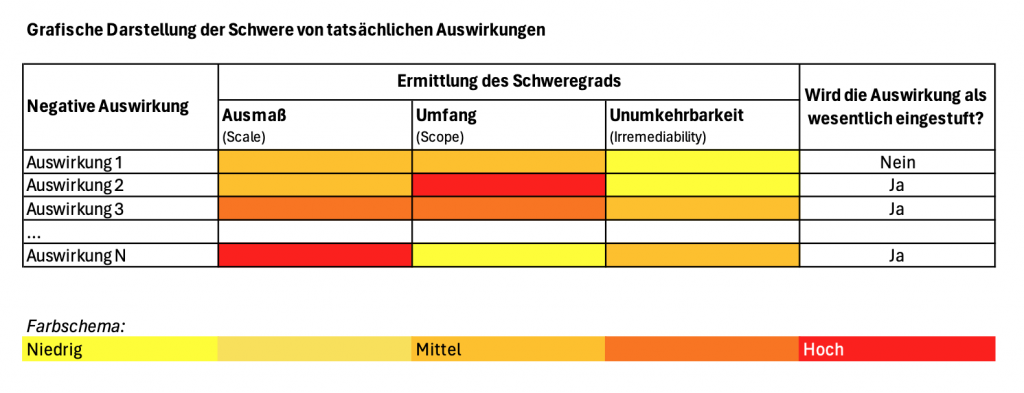
The severity of an actual or potential negative impact is assessed from the perspective of the people affected or the environment. The following characteristics are decisive here:
- Extent (scale): This concerns the severity of the impact, e.g. the extent to which basic life needs or freedoms (such as education, livelihood) are restricted.
- Scope: This is about how many people are affected or how great the environmental damage is.
- Irremediability: This refers to the extent to which the impact can be remedied, e.g. through compensation or restoration. The key question is whether and to what extent the environment or those affected can be restored to a state that is at least equivalent to that prior to the negative impact.
Each of the three characteristics can classify an impact as serious on its own. However, these characteristics are often interdependent and influence each other in their assessment.
If there is scientific consensus on the severity of certain global or local environmental impacts, it can be assumed that the impact is indeed significant without conducting a
own analysis. Companies should decide on the severity of the impact at their own discretion and on the basis of the available scientific information.
Source: Based on graphic from “[Draft] EFRAG IG 1: Materiality assessment implementation guidance”
The graphical representation serves as an example of a possible visualization of the conclusions from the impact assessment. ESRS 2 IRO-1 also requires the entity to explain how it has determined the materiality of the impact, including the qualitative and quantitative thresholds used.
The involvement of stakeholders (incl. employees) can be valuable in determining the severity and likelihood of certain impacts. Furthermore, these interest groups can help to evaluate, validate, and ensure the completeness of the Materiality Assessment results.
Financial Materiality Assessment
The list of IROs from step 2 can also serve as a basis for the assessment of financial materiality. This involves evaluating whether certain risks and opportunities are considered material. These result from impacts, dependencies or factors such as climate risks or regulatory changes. Quantitative and qualitative thresholds based on financial impacts, such as performance, the company’s financial position, cash flow and access to capital, determine whether an IRO should be classified as material.
The probability and potential financial extent of these material risks and opportunities are assessed in the short, medium and long term. Companies can also compare these with the sustainability risks from existing risk management processes. Relevant business areas and investors or other stakeholders (e.g. banks) can be included in the assessment of the IROs and ensure completeness.
If an item has been determined to be financially material, the entity determines what information to report based on materiality. ESRS 2 IRO-2 requires an explanation of the determination of the information to be disclosed in relation to the material IROs, including the use of thresholds and/or the implementation of the criteria.
In principle, information is considered material if the omission, misstatement or obscuring of this information influences the decisions of readers of the financial report (e.g. investors).
The results of the previous steps (Impact & Financial Materiality Assessment) are then summarized to create a list of material impacts, risks and opportunities (IROs), which serves as the basis for the preparation of the sustainability report. The analysis at the level of material topics (and sub-topics) must be converted into IROs if this has not already been done.
Once the individual IROs have been assessed, they can be summarized for reporting purposes. The results of the double materiality analysis should be reviewed and validated with management.
4) Create report
- the procedure for identifying and assessing its material IROs (ESRS 2 IRO-1)
- the interaction of its material IROs with its strategy and business model (ESRS 2 SBM3),
- the criteria and thresholds for determining material information for disclosure (ESRS 2 IRO-2), and
- whether and how it has interacted with stakeholders and incorporated their feedback into the process of identifying and evaluating significant IROs (ESRS 2 IRO-1).
Source: Based on graphic from “[Draft] EFRAG IG 1: Materiality assessment implementation guidance”
What Tools are Available for the Materiality Assessment?
Wesentlichkeitsanalyse Vorlage
Dieses Excel Template zur Durchführung der doppelten Wesentlichkeitsanalyse führt Sie Schritt-für-Schritt durch den Prozess und erstellt automatisiert Ihre Wesentlichkeitsmatrix.
Mehr erfahren
Which software solutions are particularly suitable?
- Materiality Master: This software has been specifically developed for conducting the double Materiality Assessment. It offers structured recording and assessment of IROs and enables the visualization of results in a dynamic materiality matrix.
- CONSUST An all-in-one ESG software that, in addition to identifying the key areas of action, also enables you to track effective targets and measures for your ESG initiatives.
- You can find more providers in our CSR tool overview.
Examples of Materiality Assessment
Interesse an einem Wesentlichkeits-Workshop?
Der 'Wesentlichkeitsanalyse Workshop' ist ein interaktiver 4-stündiger Kurs, der darauf abzielt, Ihr Unternehmen bei der Durchführung der doppelten Wesentlichkeitsanalyse gemäß den aktuellen Standards (CSRD/ESRS) zu unterstützen.
Mehr erfahren
What else is Important?
According to the CSRD and the ESRS, companies are obliged to carry out an annual materiality analysis. The assessment of materiality is a dynamic process and should be continuously updated to reflect changes, including those in the value chain.
However, if a company concludes, based on appropriate evidence, that the results of the materiality analysis from the previous reporting period are still accurate, it may use these conclusions for the preparation of the new sustainability report. This applies in particular if there have been no significant changes in the organizational and operational structure of the company and there are no significant changes in external factors that could generate new impacts, risks and opportunities (IROs) or influence the relevance of certain disclosures.
- Short-term: Period that the company has defined as the reporting period in its report.
- Medium-term: From the end of the short-term reporting period up to five years.
- Long-term: More than five years.
The parent company conducts the Materiality Assessment for the entire group of companies, regardless of the legal structure of the group and the aggregation used for the consolidated sustainability report.
It can use different approaches, such as a top-down approach, in which the valuation is carried out at Group level with the inclusion of subsidiaries for specific matters. Or a bottom-up approach, where the valuation is carried out at subsidiary level and the results are consolidated.
Trade-offs can occur in the materiality assessment at group level. The parent company must therefore consider consistent methods and thresholds for the entire group when defining thresholds. The consideration of IROs or topics related to the sectors, geographical locations or specific subsidiaries is supported by sector standards.
Companies can prioritize certain stakeholder groups in the materiality analysis by involving those who are most affected by their activities. It is not necessary to consult all stakeholders on all sustainability issues, but only those who are actually affected by the specific sustainability issues.
In general, environmental impacts are considered in the materiality assessment as gross impacts (i.e. before any mitigation measures). This serves the purpose of providing information on the company’s management of impacts over time. Therefore, the recipients of the sustainability statement receive information about the actual impacts, without distinguishing between gross and net impacts.
For potential impacts, information on the gross impacts (before considering the mitigation hierarchy), the management of these impacts (e.g. policies, measures and targets) and the understanding of the net impacts (after applying the mitigation hierarchy) are relevant.
A distinction is made between actual effects that have already occurred or are ongoing and potential effects that could occur in the short, medium or long term.
The EU Taxonomy Regulation defines criteria for certain economic activities (eligible activities) that must be fulfilled in order to contribute significantly to one of six environmental objectives. These activities must also not significantly harm the other environmental objectives and must meet minimum social safeguards requirements to be considered compliant with the taxonomy. The environmental objectives of the Taxonomy Regulation are fully reflected in the environmental topics of the ESRS.
If a company is involved in eligible activities of the EU taxonomy, this indicates that it influences the environmental objective for which the taxonomy defines a significant contribution. This information can feed into the materiality assessment, particularly in the identification of impacts, risks and opportunities (IROs), by assessing whether or not the company’s activities meet the criteria for a significant contribution and whether or not they meet the criteria for Do No Significant Harm (DNSH).