
Materiality Assessment -
brief and compact
The Double Materiality Assessment (DMA) is a central instrument of the CSRD (Corporate Sustainability Reporting Directive) and the ESRS (European Sustainability Reporting Standards). It helps companies determine which sustainability topics are relevant for their business and therefore also for their reporting. Two perspectives are considered:
- Financial materiality: How do sustainability factors affect the company?
- Impact materiality: What impact does the company have on the environment and society?
Companies that fall under the CSRD reporting obligation must conduct a Double Materiality Assessment and disclose their results in their sustainability reporting. This ensures that both financial risks and social and environmental impacts are transparently assessed.

Helpful tools for your Materiality Assessment
Materiality Master DMA Software
The best software solution for conducting the Double Materiality Assessment with AI support.
Materiality Assessment Excel Template
This Materiality Assessment template makes it easier for you to conduct your Double Materiality Assessment according to CSRD.
Materiality Assessment Workshop
Practice-oriented 4-hour workshop on conducting the materiality analysis. Physical or digital.
DMA Knowledge
1. What is the Double Materiality Assessment?
Significance of the DMA for companies
- Meets regulatory requirements: The CSRD requires many companies to conduct a Materiality Assessment.
- Increases transparency & credibility: Clear disclosure of sustainability issues for stakeholders.
- Promotes sustainable business strategies: companies recognize risks and opportunities at an early stage.
- Improves investor valuation: ESG criteria are becoming increasingly important for capital markets.
Legal basis and obligations
With the CSRD, many companies in the EU are required to conduct a Double Materiality Assessment and disclose their sustainability information in accordance with the ESRS standards. This applies in particular to large companies and listed SMEs. The exact requirements are set out in ESRS 1 “General Requirements” and ESRS 2 “General Disclosures”.
For companies, this means Those who do not carefully assess sustainability risks and impacts risk violating legal requirements and risk not only reputational damage, but also financial penalties.
2. What does Double Materiality mean?
Financial materiality
Financial materiality (also known as the outside-in perspective) refers to sustainability aspects that affect the company itself financially. This involves risks and opportunities arising from environmental, social or governance(ESG) factors that can influence a company’s financial position, performance or access to capital.
Examples of financial materiality:
- Climate risks: Rising CO₂ prices, stricter environmental regulations or extreme weather events can lead to financial burdens.
- Regulatory changes: New sustainability requirements may necessitate investments or influence business practices.
- Reputational risks: Negative public perception due to ESG violations can result in a decline in sales or loss of capital.
Relevance: Companies must disclose how sustainability risks affect their financial situation – similar to traditional financial risks.
Impact materiality
Impact materiality (also known as the inside-out perspective) looks at the company’s impact on the environment, society and governance. This is about the positive or negative effects that business activities have on people, natural resources or social structures.
Examples of impact materiality:
- Environmental impact: Greenhouse gas emissions, water consumption or waste production of a company.
- Social impact: Working conditions, human rights in the supply chain or fair pay.
- Governance factors: corporate ethics, corruption risks or diversity in management.
Relevance: Companies are obliged to present their sustainability-related impacts transparently, even if they are not directly noticeable in financial terms.
Interplay of both perspectives
Double materiality ensures that companies consider both financial risks and social and environmental impacts. Sustainability topics can be material at the same time in both dimensions- or only in one of the two perspectives. As soon as one of the perspectives is classified as material, the company must report on this topic.
Example:
- Climate change is financially significant for many companies (e.g. rising CO₂ costs) and impact-significant (e.g. due to high CO₂ emissions from the company).
- Data protection & IT security can be financially significant (risks from cyber attacks), but have no significant social impact.
- Biodiversity protection can have a high impact materiality (effects on ecosystems), but only limited financial significance for a company.
For each sustainability dimension, companies must assess whether it is financially material, impact-based from both perspectives or not material at all.
3. How is the Double Materiality Assessment conducted?
Understanding and classifying the corporate context
The first step is to analyze the company and its business model in order to understand which sustainability issues could potentially be relevant for the company. Various sources of information can be used for this:
- Internal analyses: What is the ESG relevance of the corporate strategy? What does the company’s value chain and business model look like? What products or services are sold and where is the organization located?
- Stakeholder analyses: What expectations do investors, customers, employees and NGOs have?
- Industry and market analyses: Which ESG risks are particularly relevant in the industry?
- Regulatory requirements: Which legal requirements apply (e.g. CSRD, ESRS, EU taxonomy)?
- Internal analyses: Which sustainability issues influence the corporate strategy and value chain?
Result: Together with the ESRS AR16 topic list, these company- and industry-specific topics result in a longlist of potentially material topics that will be further analyzed in the next steps.
Identification of IROs
Assessment of materiality using IROs
This phase examines which of the identified IROs and the associated topics are actually classified as material. Financial and impact materiality are assessed separately. Depending on the classification of the IRO, different factors must be assessed
- Scale: Thescale indicates the extent to which an activity or incident affects the ESG topic (IRO). A “very high” scale can indicate a significant impact, opportunity or risk.
- Scope: Thescope assesses how many people or which environmental area is affected. A “global/total” scope indicates impacts over large geographical areas or population groups.
- Reversibility: Assesses the ability to correct or mitigate a negative impact on ESG issues. “Irreversible” indicates that the impact is permanent and cannot be reversed.
- Probability: The likelihood of potential impacts or opportunities & risks on ESG issues occurring. A high probability indicates a significant risk that the impact will actually occur.
Forms of presentation of the main topics
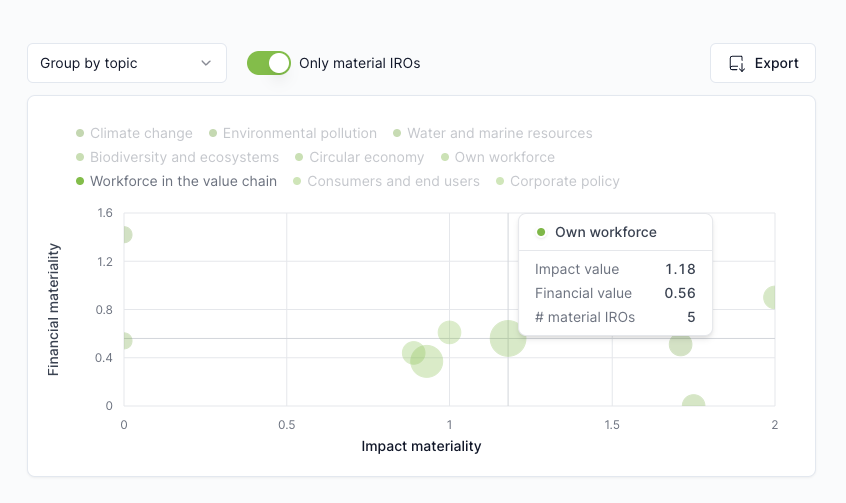
Once the relevant sustainability topics have been identified, they can be presented graphically. One of the most common forms of presentation is the materiality matrix, which depicts the topics on a two-dimensional axis. The horizontal axis shows the financial materiality, the vertical axis the impact materiality. This makes it clear which topics are particularly relevant both financially and in terms of their impact. A heat map or ranking tables are also useful for visually prioritizing the topics and focusing on the most important aspects.
Challenges in conducting the Materiality Assessment
Data availability and quality
The availability and quality of relevant ESG data is often limited. Companies should develop a targeted data strategy to identify data gaps. The use of specialized software solutions for data integration can help to ensure reliable data collection.
Involvement of relevant stakeholders in the Materiality Assessment
Involving different stakeholders can be a challenge, as it requires coordinated communication and is very time-consuming. By actively involving stakeholders (e.g. workshops and surveys), companies can ensure that all relevant perspectives are taken into account.
Interface to risk management
ESG risks and opportunities must be assessed differently to traditional risks. The use of risk management tools and impact assessment models can enable well-founded identification and quantification.
Adaptation to new regulatory requirements
Regulatory requirements such as the CSRD and ESRS are subject to constant change. Companies should regularly review their processes and ensure that they always meet the latest requirements. Close cooperation with consultants can help with this.
Complexity of the topics
The multitude of ESG topics requires in-depth analyses and interdisciplinary collaboration. Prioritization techniques, such as the Materiality Model Canvas, help to identify the most relevant topics and optimize the focus.
4. what aids and tools are available?
AI support for the Materiality Assessment
Software vs. Excel
When selecting suitable tools for conducting the DMA, companies often face the decision between specialized software solutions and conventional programs like Excel.
- Excel: Excel is widely used and is often sufficient for smaller projects, as it offers a flexible and easily accessible way to manually record and structure data and carry out initial analyses.
- Specialized software: In comparison, dedicated software solutions often offer advanced features such as automated data integration, interactive visualizations (e.g. materiality matrices) and regular updates in relation to regulatory requirements. These solutions can enable significant efficiency gains, particularly with large volumes of data and complex analysis processes.
The decision between these approaches should always be made on the basis of the individual company’s needs, the existing data volume and the complexity of the analysis. While Excel can score points as an entry-level solution, specialized software tools often offer more automation and deeper insights in the long term – provided they are used in line with the company’s requirements.
5. Materiality Assessment completed: What comes next?
Step 1: Determining the relevant data points
Based on the material topics, specific data points must now be identified. EFRAG has created and published a comprehensive list with over 1,100 ESRS data points. Since manual data point mapping of material topics to data points is very time-consuming and error-prone, it is recommended to use a data point mapping tool or possibly rely on CSRD consultants or CSRD experts.
Step 2: Gap analysis and data collection
The next step is a gap analysis to determine whether the required data is already available or still needs to be collected. Internal reporting and external sources should be checked here. If data is missing, processes must be set up to collect it.
Step 3: Preparation of the sustainability report
Step 4: Review and publication
6. Where is there further support for the Materiality Assessment?
Aids and guidelines for implementing the Materiality Assessment
- EFRAG: The EFRAG Materiality Assessment guideline (IG 1) for implementing Double Materiality helps companies understand how to conduct a Materiality Assessment and which environmental, social, and governance (ESG) topics they must address in their sustainability report. It explains step by step how to do the analysis and answers frequently asked questions about it.
- DNK: The German Sustainability Code offers a free quick guide for conducting the Double Materiality Assessment according to ESRS.
- CSR Tools articles: In our blog you will find numerous articles about the Materiality Assessment, e.g., this one: Four steps to creating a Materiality Assessment
- CSR Tools offer: Excel template for conducting the Materiality Assessment & matrix
- Materiality Master: AI-supported software for conducting the Double Materiality Assessment
- CSRD Compass Newsletter: Every 2 weeks you will receive practical implementation tips.
Further reading and links
Smart tools for your CSRD reporting!
7. frequently asked questions (FAQ)
1. What is the Double Materiality Assessment?
The Double Materiality Assessment is a process in which companies assess ESG topics both from the perspective of their financial relevance and with regard to their impacts on the environment and society. It forms the basis for transparent and integrated sustainability reporting.
2. Why is the Double Materiality Assessment important?
The analysis enables companies to identify key ESG risks and opportunities, comply with regulatory requirements such as the CSRD and ESRS and thus manage their sustainability strategy in a targeted manner.
3. Which legal requirements concern the Double Materiality Assessment?
In particular, the Corporate Sustainability Reporting Directive (CSRD) and the European Sustainability Reporting Standards (ESRS) require companies to conduct a Double Materiality Assessment and present it transparently in their reporting.
4. What does "IRO" mean in the context of the Double Materiality Assessment?
IRO stands for Impact, Risk & Opportunity. This approach ensures that companies consider not only the direct financial impact of ESG issues, but also their social and environmental impact as well as the associated risks and opportunities.
5. How is the Double Materiality Assessment conducted?
The process comprises several steps: First, relevant ESG topics are identified, followed by data point mapping and an assessment of these topics according to financial and impact materiality – often visualized in a materiality matrix. The IRO principle is incorporated into the analysis.
6. What role does data point mapping play in the analysis?
The data point mapping assigns relevant data sources to the identified ESG topics. This ensures structured data collection and integration, which is essential in order to meet the requirements of the ESRS and provide a sound basis for the analysis.
7. How can modern technologies like AI support the DMA?
AI-supported tools can analyse large amounts of data, identify patterns and trends and thus accelerate the process of prioritizing topics. The AI acts as a supporting tool, while the final assessment is still based on human expertise.
8. What are the advantages and disadvantages of specialized software compared to Excel?
Excel offers flexibility and is often sufficient for smaller projects. Specialized software solutions, on the other hand, offer advantages such as automated data integration, interactive visualizations (e.g. materiality matrix) and greater efficiency for complex analyses – which is particularly advantageous for large volumes of data and regulatory requirements.
9. How are stakeholders involved in the DMA process?
Companies involve stakeholders in the process through regular analyses, workshops and surveys. In this way, different perspectives from investors, employees, customers and NGOs are incorporated into the assessment of ESG issues and increase the acceptance of the results.
10. How is a materiality matrix created?
When creating a materiality matrix, identified ESG topics are presented on a two-dimensional graphic. One axis represents the financial relevance, the other the social and environmental impact. This allows topics to be prioritized and presented visually.
11. How often should the Double Materiality Assessment be updated?
The analysis should be reviewed and updated regularly – ideally annually or whenever there are significant changes in the business environment – to ensure that it always reflects current ESG risks, opportunities and regulatory requirements.