Summary
- Officially confirmed CSRD resolutions reduce the mandatory scope and postpone reporting deadlines.
- Despite streamlining, the effort for companies remains high.
- The CSRD offers clear opportunities for strategically sustainability-oriented companies.
- By utilizing Double Materiality, robust ESG processes, and modern reporting systems, resilience and financing opportunities can be strengthened.
- Companies can improve their market position and transform regulatory requirements into competitive advantages.
The CSRD after Omnibus: What are the implications of the new resolutions for companies, and can a competitive advantage arise from CSRD?
The Corporate Sustainability Reporting Directive (CSRD) has generated much movement and attention in the European corporate landscape since its entry into force in 2023. For many, it seems like a bureaucratic monster: complex, time-consuming, and expensive. At the same time, it is intended to lay the foundation for transparent sustainability information to make it comparable.
Has the reporting obligation only created hurdles, or does it also offer concrete added value for companies, particularly a strategic competitive advantage through the CSRD?
With the latest political decisions, the EU caused much uncertainty, but has now noticeably adjusted its course: away from excessive regulation, towards more pragmatism. However, the effort remains high – and with it, the question of how companies can specifically build a competitive advantage through CSRD.
1. Omnibus: What has changed since the end of 2025: The most important innovations
The EU agreed at the end of 2025/beginning of 2026 on comprehensive relief measures within the framework of the “Omnibus” package to ensure the competitiveness of European companies. These changes affect, among other things, the scope, transition periods, and reporting depth.
As of March 18, 2026, the new thresholds will officially finally come into force.
Due to the new thresholds, significantly fewer companies are within the mandatory scope
The new thresholds massively reduce the number of reporting entities and are intended to boost competitiveness again. Now, companies with
- over 1,000 employees are subject to reporting,
- who also record > 450 million euros in revenue.
For non-European groups, the reporting obligation only applies from €450 million in revenue in the EU, at the earliest from the financial year 2028. They must therefore publish a report for the previous financial year in 2029.
The Double Materiality Assesment
The Double Materiality Assesment remains a core component for filtering out the relevant ESRS topics. It is crucial for how well companies can realize a competitive advantage through CSRD. Companies must disclose:
- how sustainability topics financially influence their own business activities (outside-in), and
- what impact they themselves have on the environment and society (inside-out).
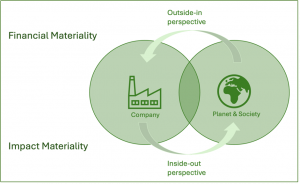
For the topics identified as material, certain data points must then be reported. The number of mandatory data points has been reduced during the revision of the EFRAG, which is intended to strengthen competitiveness and the potential competitive advantage through CSRD.
Exemptions & Transition Periods: “Stop-the-Clock” Delays Officially Approved
- For companies in “Wave 2 and 3”, the original CSRD application dates are postponed by two years.
- “Wave 1 companies“, which reported for the first time in 2024, can be exempted for 2025 and 2026 if they are no longer within scope according to the new thresholds.
- Financial holding companies without operational activities can be exempted.
The current status by "Waves"
|
Wave |
Originally subject to reporting from |
Who was meant? |
Status after “Stop-the-Clock” & Omnibus |
|
Wave 1 |
Financial year 2024 |
Companies already subject to NFRD (>500 employees) |
Still subject to reporting, but exemption possible for 2025 & 2026 if below new thresholds. |
|
Wave 2 |
Financial year 2025 |
Large companies (250+ employees or 2/3 criteria) |
Postponed by 2 years; many fall completely out of scope due to new 1,000-employee + €450 million rule. |
|
Wave 3 |
Financial year 2026 |
listed SMEs; small banks/insurers |
Also postponed by 2 years; many lose obligation due to new scope. |
2. Why does the CSRD remain challenging nonetheless?
Even with simplifications, sustainability reporting remains complex, and the path to a competitive advantage through CSRD is demanding. Three factors stand out:
High internal requirements for processes & IT
Even with simplified standards, modern reporting systems and clear responsibilities are necessary. The Double Materiality remains an important topic in terms of time commitment, requiring significant capacity. Our Materiality Master can save valuable time here as support to achieve a competitive advantage through CSRD more efficiently.
Complex data collection across the entire value chain
Despite reduced requirements, companies must still collect reliable ESG data, often across international supply chains. This remains one of the biggest cost drivers.
Reputational and liability risks
Inaccurate reports massively jeopardize trust and can impair competitiveness and thus the potential competitive advantage through CSRD.
3. Competitive advantage instead of mere compliance: Why the effort is still worthwhile
Companies that strategically use sustainability reporting gain a clear competitive advantage through CSRD.
Improved market position
Transparent ESG data strengthens competitiveness through, among other things:
- Investor confidence
- Creditworthiness
- Acceptance by customers & employees
- Access to sustainable supply chains
All of this leads to a more significant competitive advantage through CSRD.
Increased resilience and adaptation
A structured Materiality Assessment reveals risks early on. These risks can be expected CO₂ costs or supply chain dependencies, up to reputational risks. Recognizing and actively counteracting these and other risks can enable a central competitive advantage through CSRD. A climate risk analysis, for example, can specifically protect endangered locations and thus secure competitiveness.
Innovation and efficiency potentials
Sustainability analyses provide:
- Savings potential (energy, materials, processes)
- Innovation impulses for products & business models
- Competitive advantages over non-transparent competitors
Sustainability analyses thus enable savings, new business models, and clear differentiation: all drivers for a competitive advantage through CSRD.
Strategic ESG positioning
Many companies underestimate that ESG performance is increasingly becoming a decisive factor for the overall evaluation both in markets and among stakeholders. Addressing this early can become a strong competitive advantage through CSRD.
4. How companies should proceed effectively now
Despite all adjustments, it remains clear: those who approach sustainability in a structured way secure a decisive competitive advantage through CSRD. The most important steps:
1) Develop a clear ESG strategy
- Analysis of the status quo
- Concrete sustainability goals
- Integration into business processes
2) Implement Double Materiality pragmatically, but thoroughly
It remains the core of CSRD reporting and is also a strategic management tool.
3) Establish systems & tools early
Software like CSR Tools enables:
- structured data collection
- central documentation
- secure audit readiness
- standard-compliant ESRS reports
4) Make good use of transition periods and don't just wait
The transition rules are a valuable gain in time, but no reason to postpone strategic issues. Those who “just wait” now miss a great opportunity to secure a competitive advantage through CSRD.
Conclusion:
Yes, the CSRD is very complex. Nevertheless, the competitive advantage through CSRD is real, provided companies use it strategically
Despite all criticism, the CSRD remains a central building block for the future viability of European companies.
The agreed simplifications reduce pressure without sacrificing transparency and enable companies to specifically build a competitive advantage through CSRD.
Companies that understand the CSRD not just as an obligation, but as a management instrument, gain:
- Clarity about risks and thus strengthened resilience
- targeted control options
- better financing opportunities
- strengthened reputation
- innovation power and a real competitive advantage through CSRD
In short: The regulation may be an administrative hurdle, but the strategic benefit of the data gained – and thus the competitive advantage through CSRD – can be invaluable in the long run.
This blog article is a guest contribution from:

Emily Baumann
Emily Baumann lives in Frankfurt am Main. She studied Business Law at Frankfurt University of Applied Sciences and completed her studies with a Bachelor of Laws (LL.B.).
Her professional focus is in the areas of financial markets, regulation, and supervision.