Summary
-
Compact Management: The Sustainability Scorecard bundles scattered ESG data onto just two pages, creating a quick overview for management.
-
Focus Beats Completeness: Instead of getting lost in hundreds of metrics, the tool focuses on the 3–5 most important KPIs and an intuitive traffic light system.
-
Two Complementary Pages: The quantitative KPI Dashboard (Page 1) and the qualitative Maturity Check (Page 2) make progress and gaps immediately visible.
-
Versatile Use: The scorecard is equally suitable for internal management in SMEs, comparability in large corporations, and structured consulting projects.
-
5-Step Guide: The article guides you from selecting material topics and defining KPIs to the regular use of the scorecard.
Measuring, managing, and communicating sustainability – it sounds like a mammoth project. But it doesn’t have to start with a 200-page report. Sometimes one or two pages are enough to provide the crucial overview. That is exactly what a Sustainability Scorecard does: it gets straight to the point of your company’s most important sustainability metrics: compact, visual, and immediately understandable.
In this article, you will learn what a Sustainability Scorecard is, why it is relevant for companies of all sizes right now, and how to create your own scorecard in just a few steps. At the end, we provide a free PowerPoint template for download.
What is a Sustainability Scorecard?
A Sustainability Scorecard is a compact management instrument that summarizes a company’s sustainability performance on one or two pages. It shows at a glance which sustainability topics the company is pursuing, what goals have been set, where it currently stands, and whether it is on track.
At its core, the Sustainability Scorecard answers three questions:
- What are our material topics?
- How do we measure our progress?
- And where do we stand compared to our goals?
The concept is not new. Large investment firms and private equity companies already use Sustainability Scorecards systematically to evaluate and compare the ESG performance of their portfolio companies.
What works for an investment giant with hundreds of portfolio companies can also be adopted for holdings, SMEs, or consulting firms with the right adjustments. The basic idea remains the same: reduce complexity, create focus, and make progress visible.
Why do companies need a Sustainability Scorecard now?
The real added value: Internal management
The greatest benefit of a Sustainability Scorecard lies not in ESG reporting, but in internal management. In many companies, sustainability data is scattered across different departments: energy consumption in facility management, employee metrics in HR, supply chain data in procurement. There is no central overview that shows management where the company stands and where action is needed.
The Sustainability Scorecard solves this problem by bringing the most relevant data points together on one page. It thus becomes the central management tool for the sustainability strategy; comparable to a financial dashboard, but for ESG topics.
Growing external requirements
At the same time, external requirements are increasing. Sustainability reporting according to CSRD or ESRS, ISSB, , voluntary frameworks such as VSME or due diligence along the supply chain increasingly require companies to report on their ESG performance in a structured way. Banks ask for ESG ratings, customers demand sustainability information in tenders, and applicants are interested in the values of a potential employer.
The Sustainability Scorecard is not a full sustainability report. But it creates the operational foundation for sustainability to be truly managed within the company, not just reported.
Who is the Sustainability Scorecard suitable for?
The Sustainability Scorecard is deliberately designed to work for different types of organizations and use cases.
Sole proprietorships and SMEs
For small and medium-sized enterprises, the scorecard is often the first step toward structured sustainability management. It helps ESG managers communicate sustainability performance internally to management and the supervisory board. However, it can also be used externally with customers, banks, and business partners to provide the most important sustainability data clearly and professionally and to start preparing for potential ESG reporting early on.
The advantage for SMEs: The scorecard forces prioritization. Instead of getting lost in dozens of metrics, you focus on the three to five topics that are truly material to your company.
Corporations and corporate groups
For corporations, holdings, and corporate groups, the Sustainability Scorecard serves an additional function: it creates comparability. When every subsidiary or portfolio company uses the same scorecard structure, a consolidated overview of sustainability performance across all units is created.
This is particularly valuable for:
- Group management: Management at the group level can immediately see which units are on track and where action is needed.
- Investor communication: Investors and lenders receive a structured, comparable presentation of ESG performance.
- Consolidated sustainability reporting: Data collection across subsidiaries is systematized, providing a solid basis for any reporting framework.
KKR leads the way: The investment firm uses a uniform scorecard approach across hundreds of portfolio companies to identify trends, recognize risks early, and measure progress toward its self-imposed “Global Ambitions.”
Consulting firms
For sustainability consultants, ESG consultants, and auditing firms, the Sustainability Scorecard is a valuable tool in client work:
- A uniform structure to support clients of different industries and sizes in a comparable way.
- A concrete entry point for consulting projects: Instead of starting with an abstract strategy discussion, the consultant and client fill out the scorecard together.
- A documentation of progress over the duration of the consulting mandate.
The structure of a Sustainability Scorecard
Our template consists of two complementary pages that together provide a complete picture of sustainability performance.
Page 1: The KPI Dashboard
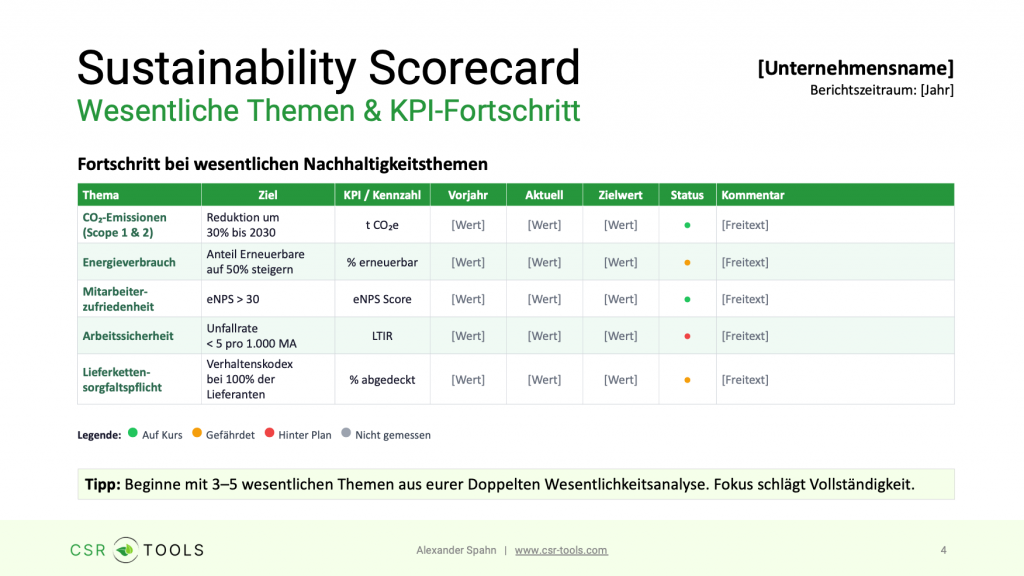
The first page is the heart of the Sustainability Scorecard. It records the quantitative progress on your company’s material topics.
The following information is recorded for each topic:
- The material topic (e.g., CO2 emissions, energy consumption, employee satisfaction)
- The specific goal you have set for yourself
- The metric / KPI used to measure progress
- Previous year’s value, current value, and target value
- A traffic light status (green / yellow / red)
- A comment field for explanations and measures
The table is deliberately limited to five rows. This may seem like little, but it is intentional: the scorecard is meant to create focus, not represent completeness.
Page 2: The Maturity Check
The second page complements the quantitative KPI Dashboard with a qualitative dimension. It shows how far your company has come in implementing basic sustainability structures and processes.
The Maturity Check covers four areas:
- Governance: Responsibilities, sustainability strategy, reporting structures, Code of Conduct
- Environment: Carbon footprint, reduction targets, climate policy
- Social: Employee surveys, diversity metrics, occupational safety
- Supply Chain: Supplier Code of Conduct, risk assessment
There are four status options for each measure: implemented, in progress, open, or not applicable. This creates a clear picture of organizational maturity – and a concrete to-do list for the next steps.
Creating a Sustainability Scorecard: A 5-Step Guide
Step 1: Identify material topics
The most important step comes first. Which sustainability topics are truly material to your company? If you have already conducted a Double Materiality Assessment, use its results as a starting point. If not, start pragmatically: ask yourself which environmental and social topics have the greatest impact on your business model.
Typical material topics for SMEs are:
- Greenhouse gas emissions (Scope 1, 2, and 3)
- Energy consumption and share of renewable energy
- Employee satisfaction and turnover
- Occupational safety
- Diversity and equal opportunity
- Supply chain due diligence
Select a maximum of five topics. It is better to manage three topics consistently than to list ten topics only on paper. Additionally, a DMA benchmark analysis can help pragmatically identify the most important topics for your industry.
Step 2: Define KPIs
For each material topic, you need a measurable metric. Use established metrics where possible. This makes comparison and reporting easier later on.
Proven KPIs include, for example:
- t CO2e (tonnes of CO2 equivalent) for greenhouse gas emissions
- % renewable energy of total consumption
- eNPS (Employee Net Promoter Score) for employee satisfaction
- LTIR (Lost Time Injury Rate) for occupational safety
- % suppliers with a signed Code of Conduct
Avoid the mistake of choosing overly complex KPIs. A simple KPI that you can actually measure is more valuable than a perfect KPI for which you have no data.
Step 3: Set goals
Formulate a specific, time-bound goal for each KPI. A good sustainability goal is specific, measurable, ambitious but realistic, and time-bound.
Examples:
- Reduction of Scope 1 and 2 emissions by 30% by 2030 (base year 2023)
- Increase the share of renewable energy to 50% by 2027
- eNPS of at least 30 from 2026
- 100% key suppliers with Code of Conduct by the end of 2025
Step 4: Conduct a Maturity Check
Go through the checklist on page two and honestly evaluate where your company stands regarding basic sustainability structures. This step shows you which organizational requirements for successful sustainability management are still missing and provides a concrete prioritization aid for the coming months.
Step 5: Update and use regularly
A Sustainability Scorecard only unfolds its full value through regular updates.
We recommend:
- Quarterly: Update KPI values and traffic light status
- Semi-annually: Review the Maturity Check
- Annually: Review material topics and goals
Use the scorecard actively: Present it in management meetings, discuss deviations, and document countermeasures in the comments column. The scorecard is not a filing document, but a management tool.
Sustainability Scorecard vs. ESG Rating: What is the difference?
A Sustainability Scorecard is an internal management tool. It is created and maintained by the company itself, based on self-selected KPIs and goals, and serves internal management and external communication. The company determines for itself which topics and metrics are relevant.
An ESG Rating, on the other hand, is an external evaluation. It is created by specialized agencies such as MSCI, Sustainalytics, or EcoVadis based on standardized methods. It primarily serves investors and lenders for risk assessment and compares companies within industries and peer groups.
Both have their place – and both complement each other. The Sustainability Scorecard provides the internal data foundation that you also need for external ESG ratings and sustainability reports.
Best practices for your Sustainability Scorecard
Less is more: Resist the temptation to pack every conceivable metric onto the scorecard. Three to five focused topics have more management impact than fifteen recorded superficially.
Honesty over window dressing: A scorecard with all green lights is either unrealistic or shows goals that are not ambitious enough. Red and yellow lights are the most valuable because they show where action is needed.
Consistency over time: The scorecard’s greatest strength unfolds over several reporting periods. Do not constantly change topics and KPIs, otherwise you will lose comparability.
Assign responsibilities: Every topic on the scorecard should have a clear owner; ideally at the management level. Without personal responsibility, the scorecard remains a toothless tiger.
Integrate into existing processes: Link the scorecard update with existing management routines, such as the quarterly review or strategy meeting. This way, maintenance is not an extra effort but part of regular business operations.
Download free template
We have created a PowerPoint template of the Sustainability Scorecard that you can use directly. The template includes the KPI Dashboard (Page 1) for recording your material topics and KPIs, as well as the Maturity Check (Page 2) with 13 concrete action ideas. The template is fully editable and can be adapted to your corporate design.
Conclusion: The best time is now
The Sustainability Scorecard is a pragmatic tool that you can bring to life within a few hours. Whether you lead a medium-sized company that wants to manage its sustainability performance in a structured way, a corporation that wants to create comparability across subsidiaries, or a consulting firm that supports its clients in a structured manner: the scorecard provides the overview you need.
Perfection is not the goal; starting is. Because as with any journey, the same applies to sustainability transformation: the most important step is the first one.