
Summary:
- Governance is the foundation of effective sustainability: It ensures that responsibilities, processes, and decisions are clearly regulated; the basis for reliable data, transparency, and implementation.
- ESG governance links reporting and management: It creates structures that enable companies to manage sustainability data, mitigate risks, and make progress transparent.
- Four phases lead to a robust governance structure:
- Diagnostic: Understand the current state, identify gaps and responsibilities.
- Design: Define target vision, roles, and decision-making rights.
- Implementation: Establish processes, systems, and controls.
- Change & Capability Building: Anchor governance and build competencies.
- Result: Governance moves from concept to lived practice – transforming sustainability from a reporting obligation into a strategic competitive advantage.
Many companies have ambitious sustainability goals, but often lack the foundation to truly implement them. Without clear responsibilities, processes, and decision-making paths, good intentions remain mere theory.
The CSRD in particular shows that sustainability only works if it is managed. ESG governance ensures that data is audit-proof, decisions are comprehensible, and measures are effective.
In short: Ambition creates motivation – structure creates results.
What does ESG governance mean in the context of sustainability and reporting?
Governance describes the framework within which decisions are made, responsibilities are regulated, and processes are managed. In the sustainability context, this means: It ensures that ESG topics are not isolated within the communications or sustainability department, but are integrated into corporate management and operational processes.
While corporate governance steers the company as a whole, ESG governance focuses on structures, roles, and control mechanisms that ensure sustainability is consistently implemented and transparently reported.
It answers questions such as:
- Who makes decisions on sustainability topics?
- Who is responsible for data, targets, and measures, and how is quality ensured?
- How are progress monitored and reported?
Good ESG governance thus creates reliability, transparency, and accountability, i.e., the basis for credible reporting and effective sustainability management.
Why is ESG governance a strategic lever?
Without clear responsibilities, decision-making rights, and control mechanisms, reporting errors and gaps between strategy and implementation arise. Sustainability goals remain declarations of intent if no one operationalizes, tracks, and evaluates them.
Clear ESG governance creates the framework to change that.
- For reporting, it ensures that data is consistent, auditable, and transparent. It thus gives executives and supervisory boards confidence to stand by the CSRD report and also strengthens the trust of other stakeholders.
- For implementation, it creates commitment and accountability and ensures that goals do not end up in a management report but are actually translated into operational measures.
- For management, governance makes it possible to measure progress and integrate sustainability into decision-making processes.
How to build an effective ESG governance structure?
A functioning ESG governance is usually a gradual development. We recommend the following four phases for building an effective structure.
Begleitung gewünscht?
Wir helfen dir, klare Verantwortlichkeiten, Datenprozesse und Reportingstrukturen aufzubauen - effizient, prüfbar und CSRD-konform. Spreche uns gerne auch bei anderen Angelegenheiten rund um Wesentlichleitsanalyse, VSME, CSRD-Software oder Nachhaltigkeitsstrategie an.
Kontakt aufnehmen
1) Diagnostic Phase: Understand the starting point
The goal of this phase is to gain a clear picture of the current ESG reporting and governance landscape. Companies should understand how ESG data is currently generated, who is responsible for it, and where breaks or duplicate structures exist. Only when the current state is transparent can realistic target structures for governance and reporting be developed.
Key questions of this phase
- Which ESG processes and responsibilities already exist formally and informally?
- Where do data breaks, inconsistencies, or gaps in responsibilities (Ownership Gaps) occur?
- Which tools and systems are currently used, and how reliable are the data sources?
- How do the interfaces between specialist departments, controlling, sustainability, and IT function?
- Assessment of existing structures
- Analysis of ESG reporting processes including ESG software solutions or Excel structures
- Identification of inconsistencies, ownership gaps, and data fragmentation between subsidiaries
- Collection and evaluation of the ESG data landscape, CSRD software, platforms, and data reliability.
- Stakeholder interviews: Provide qualitative insights into responsibilities, friction points, and priorities.
- Process Mapping: Makes complex processes and interfaces visible and provides a visual basis for improvements.
- RACI Analysis: Structures responsibilities and helps systematically close ownership gaps.
2) Design Phase: Develop governance model
The goal of this phase is to develop a viable ESG governance target vision that combines global consistency and local adaptability. After analyzing the current situation (Phase 1), the focus is now on designing a structured and clear governance architecture that clearly defines roles, responsibilities, decision-making rights, and control mechanisms. It thus creates the basis for interlocking ESRS reporting, risk management, and sustainability strategy.
- What should future governance structures look like: central, decentralized, or hybrid?
- Which roles and decision-making levels are needed (e.g., ESG Board, Steering Committees, Data Owner)?
- How can processes and data flows be standardized without ignoring local specificities?
- Which principles ensure consistency, transparency, and accountability across all units?
Typical steps
- Development of a globally uniform but regionally adaptable governance draft
- Definition of roles, definitions, and decision-making rights
- Definition of supporting standardized data processes and ESG system integration principles
Recommended methods
- Target Operating Model (TOM) Design: The TOM describes the target organization along five dimensions (structure, processes, technology, governance, and people).
- COSO Control Framework: Serves to embed internal control mechanisms (Green Controlling) and risk management into ESG processes to ensure data integrity and auditability.
- Design Workshops & Prototyping: Use of mock-ups, RACI diagrams, and process models to make governance structures visible and applicable.
3) Implementation Phase: Operationalize structures
The goal is to integrate the previously developed governance structure into the organization and make it operationally effective. This means: processes are introduced, systems are activated, responsibilities are implemented, and control mechanisms are established.
Key questions of this phase
- How are the new governance structures effectively rolled out?
- Which systems and tools support data management and reporting?
- How can consistency be ensured across all locations and units?
- Which internal controls ensure the quality and compliance of ESG data?
Typical steps
- Introduction of governance structures
- Implementation of ESG data management systems
- Standardization of reporting processes across subsidiaries/regions
- Establishment of internal control mechanisms to ensure quality and compliance
Recommended methods
- PMO Playbook: Serves to manage the implementation project – including milestones, resource planning, and escalation paths.
- DAMA-DMBOK (Data Management Body of Knowledge): Provides best practices for data quality, metadata management, and governance processes.
- ESG Data Governance Model: Ensures that ESG data is managed in a standardized and transparent way, so that it can withstand an external CSRD audit.
4) Change & Capability Building Phase: Anchor governance
The goal of this final phase is to firmly embed the new ESG governance structure within the company long-term. An ESG governance only works if it is understood, accepted, and actively practiced, from top management to operational teams. Therefore, this phase focuses on acceptance, communication, capability building, and continuous improvement.
Key questions of this phase
- How do we ensure that roles and processes are applied consistently and permanently?
- How are employees and managers empowered for their governance tasks?
- Which communication and training measures promote ownership and accountability?
- How does the governance system remain flexible enough to evolve with ESG requirements?
Typical steps (parallel to the other 3 phases)
- Implementation of structured change management and communication measures
- Development of training programs to build ownership, accountability, and digital competence throughout the company.
Recommended methods
- Kotter’s 8-Step Change Model: Supports the gradual embedding of changes, from creating a sense of urgency to institutionalization.
- Communication & Training Playbooks: Define messages, formats, and materials for training, workshops, and internal communication.
- PDCA Cycle (Plan–Do–Check–Act): Ensures continuous adaptation and improvement of governance mechanisms.
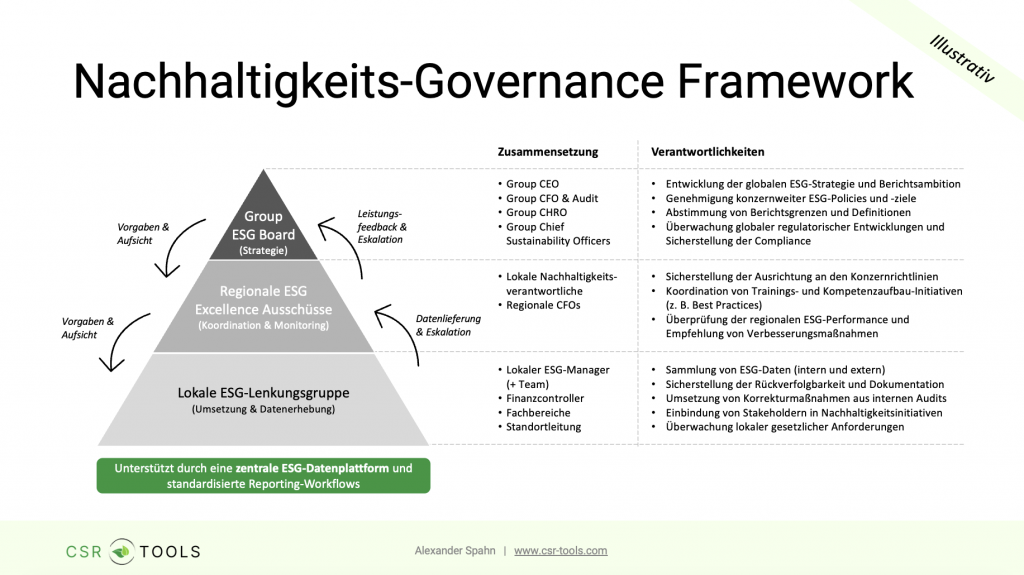
Example of an ESG Governance Framework
We have developed an exemplary governance framework for an imaginary international corporation.
Conclusion: From Governance to Impact
Good ESG governance is not an end in itself, but it is the basis for sustainability becoming manageable, measurable, and effective within the company. Those who clearly structure responsibilities, processes, and systems create transparency and trust: internally and externally.
Governance brings order to complexity: It connects strategy, reporting, and implementation into a cohesive system. Thus, sustainability becomes not an additional project, but part of daily management.