Half-time for the 2030 Agenda and its SDGs – and the results are sobering. What counts now: joint action by politics, business, and society to still achieve the sustainability goals.
Origin and character of the 2030 Agenda and the SDGs
In September 2015, at the UN Summit on Sustainable Development in New York, the 193 member states of the United Nations unanimously adopted the 2030 Agenda. This emerged against the backdrop of growing global challenges: increasing poverty, social inequalities, environmental degradation, climate change, health risks, and geopolitical conflicts. These factors demanded a new, common response from the international community.
The 2030 Agenda not only defines a global compass of values, but also a common, politically binding framework for sustainable development. Its central guiding principle is: “Leave No One Behind“ – no one should be left behind in the implementation of the sustainability goals. The Agenda is designed to meet the needs of present generations without compromising the development opportunities of future generations. It, therefore, stands for a holistic understanding of development that gives equal consideration to ecological, social, and economic aspects and sees international cooperation as the key to success.
For whom does the Agenda apply and how does it work?
The 2030 Agenda sees itself as a universal transformation program. It applies to all countries in the world, regardless of their level of development. The implementation of the Agenda is based on a participatory approach: from government and administration to business and local actors, to NGOs and citizens – all levels are called upon to contribute and actively shape change.
Particular attention is paid to the role of business: Companies are central drivers of the transformation, as their innovative strength, value creation, and market power can have significant impacts on social and ecological systems. At the international, European, and national levels, there are now numerous regulations that oblige companies to increase transparency and act responsibly in the area of sustainability. Compliance with these standards is intended to create a uniform framework that makes a significant contribution to achieving the overarching sustainability goals.
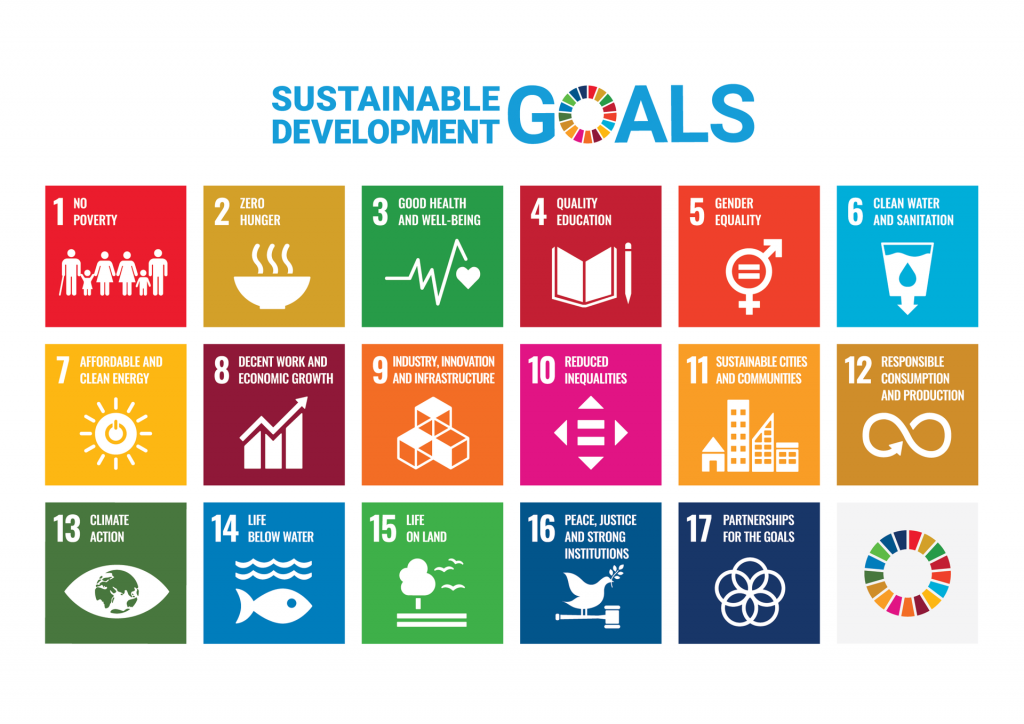
The 17 SDGs (Sustainable Development Goals) at a glance
The 17 Sustainable Development Goals (SDGs) are the core of the 2030 Agenda and form the globally recognized framework for sustainable development. The sustainability goals link ecological, social, and economic dimensions of sustainability and cover a wide spectrum. They are designed to address a wide range of issues such as poverty, inequality, climate change, environmental degradation, peace, and justice.
Current status of implementation
Ten years after the adoption of the 2030 Agenda, the international community is drawing a mixed to sobering interim balance:
- According to the 2024 Sustainable Development Goals report, only 17% of the assessable targets are achievable by 2030
- Almost half (48%) show moderate to strong deviations from the course, while 30% show insignificant and 18% moderate progress
- It is worrying that 18% are stagnating at the starting level of 2015 and 17% have fallen behind
- Factors contributing to the regression: climate change, biodiversity loss, geopolitical conflicts, persistent poverty, pandemic consequences, and unequal access to technologies
Particularly alarming is the stagnation of the following goals:
SDG 2: No Hunger
Despite global efforts, the number of people suffering from hunger is increasing: Over 100 million more people were affected in 2022 than in 2019. Wars, ongoing conflicts, and climate change are destroying cultivation regions and global supply chains, while economic shocks are driving up food prices in many countries. Above all, structural problems such as inadequate social safety nets and insufficient investment in sustainable agriculture are preventing noticeable progress.
SDG 8: Decent Work and Economic Growth
Many states are restricted by debt and lack of access to favorable financing options and cannot invest in the creation of safe and decent jobs. In these countries, many people also work in precarious and poorly secured employment relationships, often in the informal sector without social benefits or labor law protection. Their work is unstable and often not sufficient to secure an adequate income, which exacerbates social inequalities and slows economic development.
SDG 12: Responsibility in Consumption and Production
Attempts to promote sustainable consumption and production are failing due to steadily increasing resource consumption and a lack of circular economy. Companies and states continue to rely on linear models, while pollution and waste volumes are growing worldwide. Transformative progress is hampered by a lack of regulation, insufficient innovation, and low social demand for sustainable products.
SDGs 14 & 15: Loss of Biodiversity – Life Below Water & Life on Land
Biodiversity is shrinking at an alarming rate because habitats are being destroyed and overused, while pollution and climate change are additionally endangering ecosystems. The existing protective measures are not effective enough and are too rarely globally coordinated, so that many endangered species continue to disappear rapidly. Lack of international cooperation and insufficient funding are blocking the necessary large-scale protection projects.
What can companies do in concrete terms?
Companies are central actors in the implementation of sustainability goals. They face the task of systematically aligning their strategies, business models, and reports with the sustainability goals. The most important levers are:
1. Strategic Anchoring
The SDGs should be an integral part of the corporate strategy. The most relevant goals for the business model are identified via a systematic Materiality Assessment. Methods such as the IRO database from CSR Tools, which structures and prioritizes the most important impacts, risks, and opportunities, help with this. In the next step, concrete, measurable goals and measures are derived, which flow into the operative business and innovation processes.
2. Transparent Reporting and Measurability
The progress of the sustainable transformation must be documented in a comprehensible and objective manner for the stakeholders. For this purpose, companies regularly prepare sustainability reports according to recognized standards such as GRI or ESRS (within the framework of the CSRD) or DNK. The relevant SDGs are not only mentioned, but also backed up with concrete key performance indicators (KPIs), schedules, and measures. Progress indicators are continuously reviewed and adjusted if necessary. In this way, the integration of SDG indicators into digital reporting processes makes corporate performance transparent and comparable.
3. Sustainable Innovations and Processes
Companies can achieve great leverage through the development of sustainable products, circular economy, resource and energy efficiency, digitalization, and sustainable supply chains. At the same time, investments in climate protection, sustainable mobility, and biodiversity conservation can create real added value.
4. Stakeholder Involvement
Participation of employees, customers, investors, and residents through dialogue formats, partnership initiatives, social innovations, and continuous feedback – valuable impulses often come from outside.
SDG as a compass for sustainable management
The 17 Sustainable Development Goals form the international, indispensable framework for securing a sustainable, peaceful, and equitable future despite current crises and global challenges. For companies, they mean orientation, but also clear responsibility: Those who consistently anchor sustainability in their strategy and value chain not only strengthen their own competitiveness in the long term, but also create social added value at the same time.
But the closer 2030 gets, the clearer it becomes that the timeframe for implementing and achieving the SDGs is tight and many goals are in danger of failing without more decisive measures. In order for the 2030 Agenda to remain more than just a promise for the future, politics, business, and society must now act decisively together.
This blog article is a guest contribution from:

Emily Baumann
Emily Baumann lives in Frankfurt am Main. She studied Business Law at Frankfurt University of Applied Sciences and completed her studies with a Bachelor of Laws (LL.B.).
Her professional focus is in the areas of financial markets, regulation, and supervision.