
Important Note (February 26, 2025):
Some details of this article may be outdated due to the current EU Omnibus Proposal. This particularly concerns the scope and deadlines of the CSRD. For current information and implications for companies, please read our blog post on CSRD Omnibus – What the EU Proposal Means for Companies. All other content remains valid.
The new European Sustainability Reporting Standards (ESRS) present companies with the challenge of collecting and correctly reporting a large number of ESRS data points on their ESG performance. ESRS data point mapping plays a central role here. It is the transfer from the double materiality assessment to the information provided in the CSRD report must be made.
In this blog article, we give you insights into the data points and seven essential tips on how to make mapping efficient, avoid pitfalls and create a robust basis for your sustainability reporting in accordance with CSRD.
Key Takeaways
The ESRS Data Point Mapping is the crucial intermediate step between Materiality Assessment and the CSRD report. From over 1,000 possible data points, companies must filter out the relevant mandatory disclosures and assign them to the material topics.
Challenge: Large data volumes, phase-in rules, and voluntary disclosures can quickly lead to complexity.
Solution: With clear filtering, a structured Excel setup, and tools like the CSR Tools Mapping Tool, effort and costs can be significantly reduced.
Practical Tip: Supplement the table with responsibilities, data sources, and availabilities – this way, it becomes the central basis (“Single Source of Truth”) for robust CSRD reporting.
What is EFRAG's ESRS Data Point Overview?
The European Financial Reporting Advisory Group (EFRAG) has gone through the disclosure requirements of the European Sustainability Reporting Standards point by point and transferred them into an Excel spreadsheet.
Facts about the ESRS data points table
Exciting figures and insights into the data points (DPs).
Note: The updated ESRS proposals (as of July 2025) provide significantly fewer data points than the original version of the European Sustainability Reporting Standards did. Accordingly, approximately 330 data points remain. This is shown by the (unvalidated) updated Data Point List of the Sustainability Reporting Navigator.
For companies with fewer than 750 employees, “only” fewer than 500 data points remain. Which data must ultimately be published in the CSRD report depends on the results of the double materiality assessment. More precisely, the list of material topics, sub-topics and sub-sub-topics.
Number of data points according to ESRS standards
- ESRS 2 General data: 219 data points
- E1 Climate change: 214 data points
- E2 Pollution: 96 data points
- E3 Water and marine resources: 48 data points
- E4 Biodiversity and ecosystems: 122 data points
- E5 Circular economy: 64 Data points
- S1 Own Workforce: 196 data points
- S2 Workers in the value chain: 67 data points
- S3 Affected communities: 66 data points
- S4 Consumers and end users: 66 data points
- G1 Business conduct: 53 data points
What is the Best Way to Filter out Mandatory Disclosures (Tips 1 to 3)?
To organize the large amount of data points more clearly, the following columns should be filtered to narrow down the mandatory information:
- May [V] (column I): Data points marked with a “V” and highlighted in orange (312 DPs) are voluntary and not mandatory. These can be filtered out.
- Phase-in <750 employees (column K): For companies with less than 750 employees, this shows whether a data point (553 DPs) is being phased in. The indication in years shows how long after the first reporting year the disclosure obligation can be suspended.
- Phase-in (column L): Irrespective of the company size, this indicates whether a data point (122 DPs) is being introduced in stages.
How to Map ESRS Data Points?
IROs are identified and evaluated in the double materiality assessment process. As a result, it is known which topics have been classified as material, but an important intermediate step is still required to record the data points to be reported: ESRS data point mapping.
Use a data point mapping tool (tip 4)
Despite the CSRD assistance provided by EFRAG, linking the key topics to the data points requires manual effort. CSRD Experts need approx. 3-5 days for manual mapping. This time and the associated costs can be saved in the future thanks to our data point mapping tool.
Our innovative data point mapping tool allows you to upload your material topics as an Excel file or enter them manually in our system. The tool then provides the list of key data points for your sustainability report at the touch of a button.
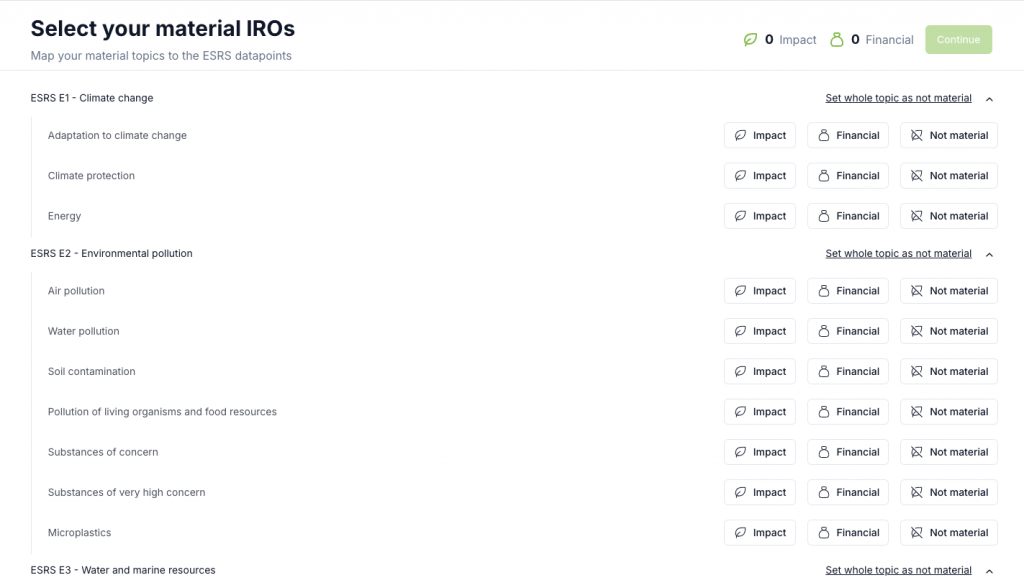
The mapping tool is compatible with our materiality assessment Excel template and the DMA software solution ‘Materiality Master‘. However, other ESG software solutions and templates can also be used for materiality assessment.
Extend Excel file data points (Tip 5-7)
Regardless of whether you carry out the mapping manually or with our tool, we recommend adding additional columns to the table. This will create an optimal basis for your CSRD report.
- Responsibility: Who is responsible for the respective data point?
- Data availability: Is this information already collected?
- Source/system: Where does the data come from or in which system is it stored?