The Corporate Sustainability Reporting Directive (CSRD) is causing a stir in the SME sector: while many companies have been affected by the EU omnibus will no longer be obliged to publish a sustainability report in future, numerous companies are nevertheless opting for voluntary reporting in accordance with the VSME standard – whether out of conviction, at the request of customers or in preparation for future requirements.
But what to do when time, budget and human resources are limited? This is exactly where materiality assessment Light comes in: a lean, practical approach for companies that take sustainability seriously but don’t want bureaucratic monster processes.
In this article, we show you what makes up materiality assessment Light, which steps you absolutely need – and which you can consciously do without. Ideal for anyone who wants to work in a pragmatic, focused and yet CSRD-oriented way.
Materiality Analysis Light vs. comprehensive DMA?
What is the double materiality assessment (DMA)?
The double materiality assessment (DMA) is at the heart of CSRD-compliant sustainability reporting. It helps companies to determine which sustainability topics are actually relevant – i.e. material – and therefore need to be included in the report.
“Double” means that two perspectives must be taken into account:
- Impact materiality: In other words, the company’s impact on the environment and society (e.g. CO₂ emissions, working conditions).
- Financial materiality: In other words, the financial risks and opportunities that arise for the company from sustainability issues (e.g. climate risks, regulatory changes, market trends).
An issue is considered material if one of these two perspectives applies. The DMA is therefore more than just a tick box for compliance – it is a strategic tool that helps companies to focus on the really important issues.
The catch: a complete DMA is complex, expensive and often difficult to implement – especially for smaller companies. This is precisely why a leaner approach is needed: materiality assessment Light.
What is a "materiality assessment Light"?
Since the VSME update of December 2024, DMA is no longer mandatory for the voluntary sustainability report. Nevertheless, it is advisable – also from the perspective of the sustainability strategy – to carry out a materiality assessment.
The materiality assessment Light is a reduced, pragmatic version of the double materiality assessment according to CSRD and ESRS. It is aimed at companies – especially SMEs – that, for example, want to publish a voluntary VSME sustainability report report, for example.
Mandatory program: Every materiality assessment Light needs these 5 elements
While the full materiality assessment requires extensive stakeholder dialog, detailed assessments and comprehensive documentation, the light version concentrates on the essentials in the best sense of the word. But a he same applies to the DMA Light version: materiality assessment does not work without substance – even if it is voluntary.
-
double materiality retained
The analysis must cover both impact and financial perspectives. A topic can therefore be material either “from the inside out” or “from the outside in” – or both.
2. identify IROs
The basis of every materiality assessment are the so-called IROs (Impacts, Risks & Opportunities). These should be recorded in a structured manner, ideally with the help of ready-made catalogs (e.g. the IRO database from CSR Tools). A complete inventory is not necessary – but a comprehensible selection is.
3. simplified valuations
You don’t need a quantitative high-end assessment model. A qualitative assessment is completely sufficient – for example with the categories high / medium / low for each assessment aspect (extent, scope, reversibility, probability). It is advisable to retain the assessment aspects and logic in order to be able to switch to the CSRD at a later date.
4. include the stakeholder perspective
No elaborate interviews or surveys – but a desk-based look at relevant stakeholder interests (e.g. customer expectations, regulatory developments, industry standards) should be carried out. This can be covered by industry reports, market analyses or internal assessments.
5. documentation of the procedure
Transparency beats perfection: It is important that you document in a comprehensible way how you arrived at your results. Who was involved? Which sources were used? Which criteria were decisive? This documentation is worth its weight in gold, especially in the event of queries from customers, banks or potential auditors, but is also relevant for internal traceability.
The focus is on rapid feasibility and results that are easy to implement, but which enable an easy transition to a CSRD-compliant materiality assessment. The aim is not to water down the process, but to make it manageable – for companies that take sustainability seriously but operate with limited resources. The materiality assessment Light is therefore also a door opener: it provides a structured introduction to ESG reporting without getting lost in complexity.
You can do without these elements in the Light version
Here’s what you can (consciously) save yourself:
- Extensive stakeholder surveys: You don’t have to launch an external survey. The stakeholder perspective can also be incorporated through desk research, market analyses or internal discussions, e.g. using existing employee surveys and supplier surveys.
- Assessment at sub-sub-topic level: An assessment at the lowest level of granularity – e.g. for individual sub-sub-topics – is not necessary. An assessment at topic level is sufficient, as the VSME standard also operates predominantly at this level of aggregation. This saves time and corresponds to the reality of many SMEs.
- Complete analysis of the value chain: The analysis of Tier 1 suppliers and direct customers and rough assessments of their ESG risks and impacts are completely sufficient. No detailed location analysis or tracking of the entire value chain necessary.
- Heatmaps, spider charts & matrix visualizations: Visual representations can help – but are not a must. A simple table or list is enough to present your results transparently. The VSME mapping of the reporting obligations for the ESRS topics is also helpful here.
- External validation or CSRD audit: You do not need any certificates or external expert opinions as long as you report voluntarily. Credibility comes from traceability – not perfection. Nevertheless, a plausibility assessment (certification in accordance with IDW S7), for example, can be useful for companies. You can find more information on this in the recording and the questions and answers to our VSME webinar.
By consciously avoiding these points, you save time, money and nerves – without losing the essence of materiality assessment.
Efficient process for materiality assessment Light
A materiality assessment Light doesn’t have to be complicated – but it should be structured. The following four steps outline a lean but effective process that will help you quickly achieve resilient results without a large team.
Materiality Assessment Light Excel template and software solution
We are currently adapting our popular materiality assessment Excel template to enable DMA Light. Interested?
We will also be offering a DMA Light option in our Materiality Master software soon.
Step 1: Preselection of relevant topics
The first step is to narrow down the topics. Instead of checking all 10 ESRS topics across the board, you can take a targeted approach:
- Which topics are typically relevant in your industry?
- What regulatory trends, market requirements or industry guidelines play a role?
Here it is advisable to use ready-made industry shortlists, such as the Industry Materiality Map from MSCI or the Materiality Finder from SASB. The list of relevant topics should be checked again and compared with the company’s business model and activities.
Step 2: Selection of IROs within the relevant topics
Within the identified topics, specific IROs are now selected that fit the company’s business model and activities:
- What (potential) effects, risks or opportunities are associated with the topic?
- Which IROs are realistic and plausible in relation to your company?
IROs can be created using materiality assessment AI prompts, for example, or by selecting pre-formulated IRO examples from a database.
IRO-Datenbank
Die IRO-Datenbank liefert Ihnen zahlreiche vorformulierte Impacts, Risks und Opportunities für Ihre ESRS-konforme Wesentlichkeitsanalyse.
Mehr erfahren
Step 3: Evaluation of the IROs
The third step is the qualitative assessment of the selected IROs along the lines of double materiality in accordance with the defined assessment criteria.
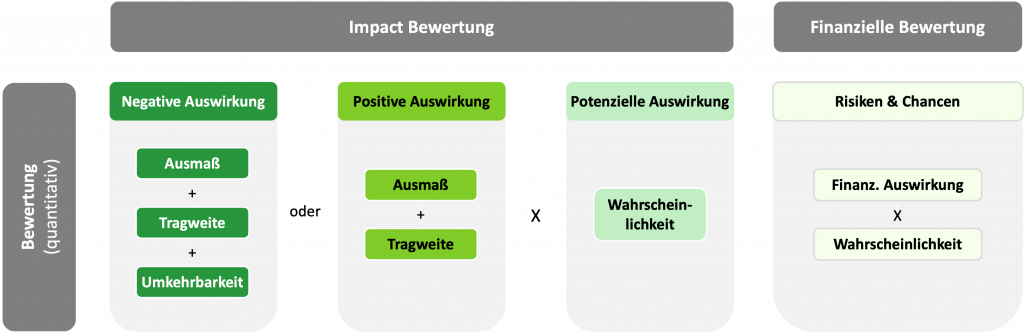
It makes sense to use a simple 3-stage selection as a scale: Low, Medium, High.
Step 4: Documentation and stakeholder involvement (optional)
If the assessment was carried out exclusively by the core tesm, it could be helpful to involve other internal stakeholders to validate the topics and assessments.
It is also documented:
- Which stakeholder perspectives were included in the assessment?
- What documents, sources or evidence support the IRO’s selection and assessment?
This documentation creates traceability – and makes it possible to delve deeper or update the analysis if necessary. If the DMA are checked on a voluntary basis, the documentation is particularly helpful.
Advantages of materiality assessment Light
materiality assessment Light offers a whole range of specific advantages. It combines structure with feasibility – without losing the claim to systematically cover relevant sustainability topics.
✅ Less time and resources required
The process is designed in such a way that it can also be carried out with a small team and manageable effort – without workshops, large-scale projects or external stakeholder dialogs.
✅ Getting started with sustainability reporting
The light analysis enables a low-threshold start that can easily be expanded later – e.g. as part of a full DMA analysis as soon as more capacities or obligations exist.
✅ Connectable to VSME & CSRD
Even if it is leaner: materiality assessment Light is clearly based on the basic principles of the CSRD and the VSME standards. This makes it more than just an internal ESG tool – it is reportable. Our VSME data point list and the VSME report template in Word format are helpful and pragmatic tools for your report.
✅ Internal clarity & strategic overview
The structured selection and evaluation of IROs makes it clear which topics are really relevant – for customers, investors, banks or regulatory developments. This makes sustainability a top priority with a clear database.
✅ Lower risk with increasing requirements
Those who report voluntarily today will be better prepared tomorrow: materiality assessment Light helps you to prepare for future regulations at an early stage – and creates a solid basis for future expansions.
Conclusion
materiality assessment Light is not a compromise – it is a practical response to the challenges faced by many small and medium-sized companies: limited resources, high expectations and the desire to approach sustainability in a structured but feasible way.
By concentrating on the essentials – topic level instead of obsessive detail, clear IRO assessment, effective integration of stakeholder perspectives – it provides a genuine introduction to CSRD logic without overburdening companies. Anyone wishing to report voluntarily in accordance with the VSME standard is thus provided with a lean, connectable tool that has an impact – both internally and externally.