With the Corporate Sustainability Reporting Directive (CSRD), the EU is setting new, significantly more demanding requirements for corporate sustainability reporting. The goal: In the future, companies should report more transparently on environmental, social, and governance (ESG) issues – standardized, digitized, and auditable. This affects not only large enterprises, but also, in stages, medium-sized capital companies and many subsidiaries of international groups.
1. The CSRD Implementation Act 2025 at a Glance
In Germany, a revised draft bill for the CSRD Implementation Act has been available since July 2025. It regulates, among other things:
Extended Reporting Obligations in the HGB: Sustainability information will become part of the (group) management report (§§ 289b et seq., § 315b HGB-E).
Introduction of the Audit Obligation: The sustainability report is subject to an independent audit with limited assurance by auditors, potentially also by other auditing bodies in the future.
ESEF Format Requirements: In the future, management reports, including sustainability disclosures, are to be mandatorily prepared in the electronic reporting format (XHTML with XBRL tagging).
New Thresholds and Exemption Clauses: The definition of which companies are subject to reporting will be revised; smaller subsidiaries could be exempted under certain conditions.
At the same time, there is great uncertainty, as the European Omnibus Directive for improving the CSRD is still in flux in parallel, with possible changes to reporting content, deadlines, and obligations.
The consequence: Companies and associations are sounding the alarm. In their statements on the CSRD Implementation Act 2025, they criticize a lack of practical applicability, additional technical effort, and open legal questions. They demand improvements before the law is passed.
In this article, we take a closer look:
- What demands and proposals do leading players such as IDW, WPK, DRSC, the German Equity Institute, the German Banking Industry Committee, and the VDZ put forward?
- Where is there consensus and where do opinions diverge?
- And: What does all this mean for companies that will have to report in the future?
2. Who is behind the Statements? The most Important Players at a Glance
In the course of the debate surrounding the German CSRD implementation, numerous stakeholders have spoken out. Six organizations, in particular, play a central role. They represent, among others, auditors, the capital market, the real economy, industries with high reporting obligations, and accounting standard setters. Each brings its specific perspective.
1. IDW – Institute of Public Auditors in Germany
The IDW represents the professional interests of auditors. It pays particular attention to the requirements for auditing the sustainability report, handling digital reporting formats, and defining audit obligations.
2. WPK – Chamber of Public Accountants
As a public corporation, the WPK intensively deals with the legal framework of auditing. It demands clear delineations of auditor roles and warns against excessive requirements for auditors and audited companies.
3. DRSC – German Accounting Standards Committee
The DRSC develops German accounting standards and represents Germany at the European level in the development of the ESRS (European Sustainability Reporting Standards). It particularly demands technical feasibility and coherence in the interplay between sustainability and financial reporting.
4. German Equity Institute (DAI)
The DAI speaks for capital market-oriented companies and strongly focuses on bureaucracy costs, international competitiveness, and deadlines for implementation and auditing. It demands more practical relevance and flexibility for capital market-oriented companies.
5. German Banking Industry Committee (DK)
As the umbrella organization for banks and savings banks, the DK is primarily concerned with feasibility in the financial sector. It emphasizes the risks of incoherent timelines and advocates for clear exemption rules and a reliable legal framework.
6. VDZ – Association of German Cement Manufacturers
The VDZ represents the interests of the cement industry, an energy-intensive basic materials sector with high reporting obligations along the supply and production chain. It demands a practical and proportionate implementation, particularly to avoid duplicate reporting obligations and unnecessary regulatory burdens.
These six statements show: The CSRD Implementation Act 2025 encounters a broad field – from auditing professions to affected industries. And precisely in their diversity, they reflect which political and practical decisions must now be made.
3. What Do the Associations Demand? Key Criticisms at a Glance
The six statements on the CSRD Implementation Act 2025 differ in detail, but many demands are similar in their thrust: Less complexity, more clarity, more practical applicability. Here are the key points summarized briefly for each association:
IDW – Institute of Public Auditors in Germany
Retention of auditing by public accountants with clearly regulated additional qualifications.
Demand for a realistic timeline for introduction and audit obligations.
Rejection of the ESEF preparation obligation for the management report, disclosure solution preferred.
Auditing should be risk-oriented and based on existing processes.
WPK – Chamber of Public Accountants
Secure strict audit sovereignty with public accountants – no softening in favor of other providers.
Clear limitation of the scope of audit to formal and substantively plausible auditing (Limited Assurance).
Warning against additional bureaucracy due to technical formats like ESEF.
DRSC – German Accounting Standards Committee
Rejection of the preparation obligation in ESEF format: causes additional effort, legal uncertainty, and media discontinuities.
Demand for a disclosure solution analogous to previous financial reporting.
Emphasize consistency of sustainability and financial reporting (“connectivity”).
Criticism of technical ambiguity (e.g., regarding XBRL taxonomy, archiving, signature).
German Equity Institute (DAI)
Rejection of mandatory ESEF preparation – especially for non-capital market-oriented companies.
Introduction of a “one-stop report” to avoid parallel reporting obligations (e.g., LkSG).
More flexible transition periods and more implementation leeway for companies demanded.
Audit obligation by public accountants with industry-specific additional qualifications supported.
German Banking Industry Committee (DK)
Warns against a hasty entry into force and demands adaptation to ongoing EU procedures.
Open questions regarding group exemption and intertwining of deadlines within corporate groups.
Supports the disclosure solution for the ESEF format.
Suggests more practical definitions for audit content and consolidation scope.
VDZ – Association of German Cement Manufacturers E.V.
Start national implementation only after completion of EU adjustments (“Omnibus”).
Reduction of duplicate reporting obligations (CSRD vs. LkSG) urgently needed.
Criticism of ESEF obligation as impractical, especially for medium-sized companies.
Admission of further auditors besides public accountants proposed to relieve the market.
4. What Unites and Divides the Associations
The six statements on the CSRD Implementation Act 2025 differ in tone, but not always in content. While the perspectives vary – auditors, reporters, standard setters – clear patterns emerge in central aspects. In other areas, however, the views are quite controversial.
4.1 Common Demands: more Pragmatism, less Complexity
Rejection of the ESEF Preparation Obligation
All six organizations oppose the mandatory preparation of the management report in ESEF/XHTML format. Instead, the so-called disclosure solution is preferred – i.e., digital formatting solely for the purpose of publication, not as a legally authoritative document.
Priority for Practical Applicability and Legal Certainty
There is agreement that the draft law is rushed. Many demand that it should only come into force after the completion of the EU-wide “Omnibus” adjustments. Because: Companies need clarity on what applies when for whom.
Avoidance of Duplicate Reporting Obligations
In particular, the German Equity Institute, the VDZ, and the DK urge to harmonize sustainability reporting with other legal reporting obligations (e.g., Supply Chain Due Diligence Act). The idea: A “one-stop report.”
Limited Audit Scope with Clear Responsibility
There is agreement that the audit of the sustainability report must not escalate into a full audit. The demanded “Limited Assurance” should remain consistent. The IDW, WPK, and DAI emphasize the priority of public accountants – while also requiring practical qualifications.
Align Consolidation Scope with Financial Reporting
Several organizations – especially DRSC, DK, and VDZ – demand that the sustainability report be allowed to use the same consolidation scope as financial reporting. This is intended to reduce effort and improve comparability.
4.2 Controversies and Differences: who may Audit and to What Extent?
Despite many agreements, clear differences emerge on some issues:
Who may audit?
While IDW and WPK strictly insist on auditing by public accountants, the VDZ is more open: Other qualified auditors should also be admitted to avoid capacity bottlenecks.
Technology vs. Feasibility
The DRSC criticizes the draft in particularly detailed technical terms – focusing on iXBRL, signature requirements, media discontinuities, and format issues. Others, like the DAI or the VDZ, rather emphasize the bureaucratic effort for companies and demand simple solutions.
Timing of Implementation
While DRSC and DK specifically point to the ongoing EU adjustments and their delays, WPK and IDW express themselves more cautiously and focus more on substantive design than on deadline postponement.
Industry Interests
The differences often reflect industry-specific interests:
The DAI focuses on listed large enterprises.
The DK thinks in terms of group structures and reporting obligations along the group.
The VDZ is one of the few to bring in the perspective of an energy-intensive industry that particularly suffers from regulatory burden.
4.3 Interim Conclusion
The associations do not want a “return to voluntary CSR,” but they demand a realistic and implementable sustainability reporting that does not overwhelm companies with bureaucracy – and that fulfills the actual purpose of the CSRD: credible, traceable sustainability data.
5. Comparison of Statements: who Stands where?
To make the complexity of the statements tangible, we have summarized the core statements on the central aspects in a table:
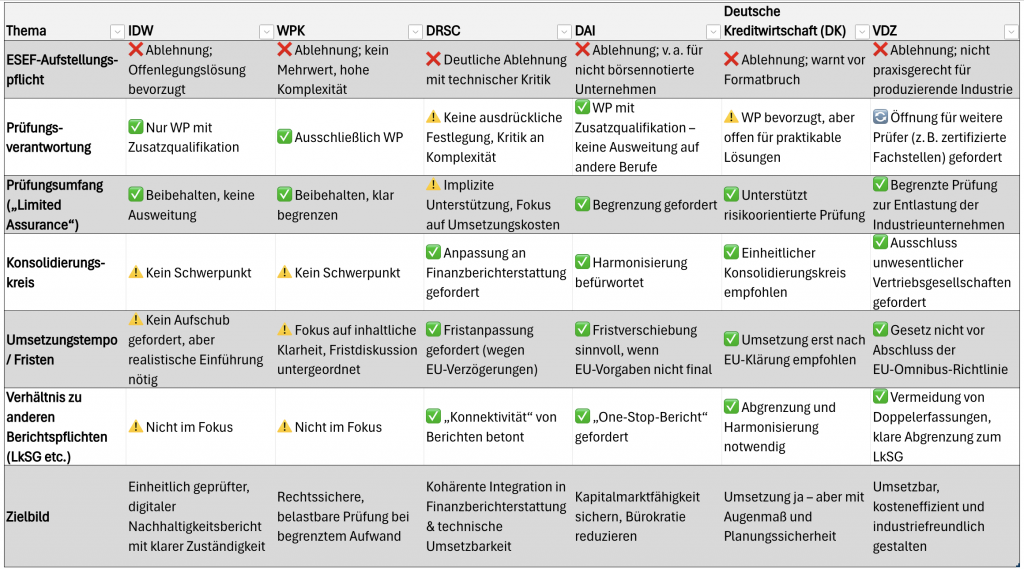
Despite different focuses, the associations share a common goal: The implementation of the CSRD should be legally compliant, but also economically viable and technically manageable. The ESEF preparation, audit obligations, and harmonization with other laws are particularly in focus, with sometimes very clear demands on the legislator.
6. Conclusion: a Law with Repercussions
The draft bill for the CSRD Implementation Act 2025 is more than a technical update of the HGB – it is a balancing act between EU requirements and national implementability. The associations’ statements clearly show: In its current form, the law is largely not practical.
6.1 What the Legislator should Take Away
The unanimous rejection of the ESEF preparation obligation for the management report is a clear signal. The disclosure solution is tried and tested in practice and offers the same transparency – without the massive additional technical effort.
The audit by public accountants is generally supported – but it must be efficient, risk-oriented, and not artificially complicated. The discussion about opening up to other auditors is a question of capacity and trust.
Companies need legal certainty – and no changes during ongoing operations. The legislator should adapt the timeline to the EU process and not set implementation deadlines before Brussels has finalized its position.
A “one-stop report” that consolidates various reporting obligations (e.g., CSRD, LkSG) would be a real step forward – and would reduce bureaucracy instead of building it up.
6.2 What Companies Can Do Now
Even if the law is not yet final: The direction is clear. The CSRD is coming – and it will require structured, auditable ESG data in the future.
Companies should proactively address the interlinking of sustainability and financial reporting, clarify responsibilities, and build competencies.
Those operating internationally should analyze potential consolidation obligations and reporting obligations within the group – otherwise, unexpected additional effort threatens here.
6.3 What this Means for Practice
Sustainability reporting will become an integral part of corporate communication – legally binding, auditable, and public. The political course for this is being set now. If the associations’ recommendations are heard, the CSRD Implementation Act 2025 could be not just a regulatory text, but a functional framework for greater sustainability transparency.
7. Further Links and Tools
The CSRD and its national implementation will intensively occupy many companies, consultants, and auditors in the coming months. Those who want to be well-prepared should now have the right information sources and tools at hand.
Official Documents and Statements
Draft bill of the Federal Ministry of Justice (BMJ) for the CSRD Implementation Act 2025.
The six analyzed statements:
Our tools and consulting services related to the CSRD: https://csr-tools.com/produkte/