The European Sustainability Reporting Standards (ESRS) form the core of the EU’s Corporate Sustainability Reporting Directive (CSRD). Previously, the structure was three-tiered:
- Topics (e.g., climate change, biodiversity, workforce),
- Sub-topics,
- Sub-sub-topics (e.g., specific aspects like child labor, water withdrawal, or animal welfare).
This level of detail offered the advantage of clear guidance but brought high complexity for many companies, especially small and medium-sized enterprises (SMEs).
Planned Changes to the ESRS Topic Structure: from Three to Two Tiers
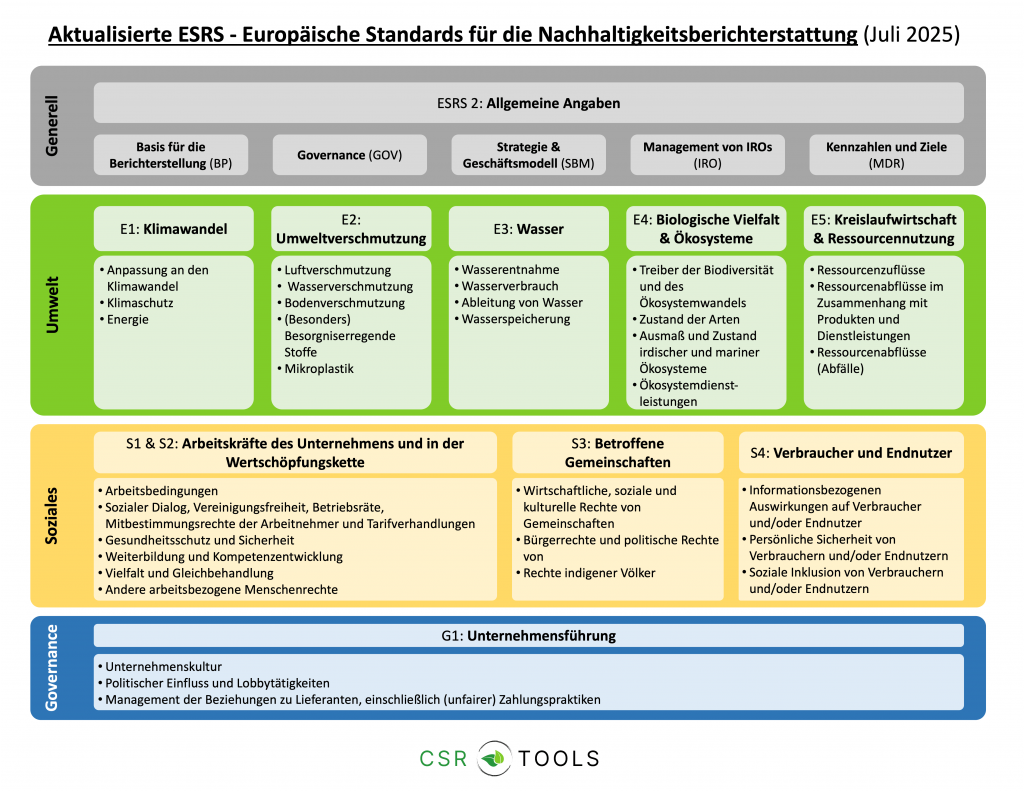
The current proposal for adapting the ESRS (as of July 2025) foresees a streamlining: In the future, there will only be topics + sub-topics. Sub-sub-topics will be removed or integrated into the higher level.
Key Changes at a Glance:
- E1 Climate Change: No changes – focus remains on climate protection, adaptation, and energy.
- E2 Pollution: “Pollution of living organisms and food resources” is removed (too sector-specific, hardly measurable). Substance-related topics are merged.
- E3 Water & Marine Resources: Sub-sub-topics like “water consumption” become independent sub-topics. “Discharge into oceans” is removed, “water storage” is newly added. The use of marine resources will be covered in other standards in the future.
- E4 Biodiversity & Ecosystems: Drivers such as invasive species are expanded. Examples (species extinction, land degradation) are removed – more flexibility, fewer checklists.
- E5 Circular Economy: Resource inflows and outflows remain, but services are now also considered. Marine resources are moved here.
- S1 & S2 Workforce: Own employees and value chain are merged – a unified logic for HR topics.
- S3 Affected Communities: Detailed topics (housing, nutrition, safety) are integrated into broader categories.
- S4 Consumers & End-users: Data protection, child protection, access to information, etc., merge into larger blocks.
- G1 Corporate Governance: Topics such as corruption, whistleblowing, and animal welfare are no longer reported individually, but within the framework of “corporate culture.”
Why are these Changes to the ESRS Topic Structure Being Proposed?
The European Commission and EFRAG aim to achieve the following with the restructuring under the Omnibus Proposal:
- Reduce complexity: Especially for SMEs, who might be overwhelmed by the CSRD reporting obligation, the reduction of the ESRS topic structure offers a simplification.
- Create more flexibility: Companies should no longer tick off rigid checklists but identify relevant topics for their context. They can choose between a top-down and a bottom-up approach for identifying material topics.
- Strengthen Double Materiality Assesment (DMA): Companies must prioritize for themselves, through the Materiality Assessment, which topics are material to them and thus subject to reporting.
Who is this Relevant for?
- SMEs and mid-sized companies that will no longer fall under the CSRD obligation in the future but still wish to publish a simplified sustainability report on a voluntary basis (e.g., VSME Standard) → fewer detailed requirements, but more self-responsibility.
- Large companies that must report comprehensively under the CSRD → they benefit from a clearer structure but must carefully assess whether removed details remain material for their industry.
- CSRD consultancies, ESG software providers (such as Materiality Master) and auditors, who need to adapt their tools and processes.
Important: the Topic Structure is not yet Final
The changes are still in the proposal stage (Exposure Draft July 2025) as of August 2025. A final adoption is still pending. However, companies should already familiarize themselves with the possible changes to be prepared, especially regarding the execution of the Double Materiality Assesment and internal processes.
Note: The adjustment of the ESRS topic structure is just one of numerous proposed changes in the ESRS Set 1 Exposure Draft.
Detailed Overview of all Changes in the ESRS Topic Structure
| ESRS topic | Original sub-sub-topic | New mapping in 2025 proposal | Status / change | Note / rationale |
|---|---|---|---|---|
| E1 Climate change | Climate change mitigation | Climate change mitigation | Unchanged | |
| E1 Climate change | Climate change adaptation | Climate change adaptation | Unchanged | |
| E1 Climate change | Energy | Energy | Unchanged | |
| E2 Pollution | Pollution of air | Pollution of air | Unchanged | |
| E2 Pollution | Pollution of water | Pollution of water | Unchanged | |
| E2 Pollution | Pollution of soil | Pollution of soil | Unchanged | |
| E2 Pollution | Pollution of living organisms and food resources | Removed | Removed | No disclosure / too sector-specific |
| E2 Pollution | Substances of concern | Substances of concern (incl. very high concern) | Merged | Merged with “very high concern” |
| E2 Pollution | Substances of very high concern | Substances of concern (incl. very high concern) | Merged | Merged into “concern” |
| E2 Pollution | Microplastics | Microplastics | Unchanged | |
| E3 Water & marine resources | Water consumption | Water consumption (now sub-topic) | Moved | From sub-sub → sub-topic |
| E3 Water & marine resources | Water withdrawals | Water withdrawals (now sub-topic) | Moved | From sub-sub → sub-topic |
| E3 Water & marine resources | Water discharges | Water discharges (now sub-topic) | Moved | From sub-sub → sub-topic |
| E3 Water & marine resources | Water discharges into oceans | Removed | Removed | Covered via ESRS 1 |
| E3 Water & marine resources | Water storage | Water storage | New | Newly introduced |
| E3 Water & marine resources | Extraction & use of marine resources | Moved to E5 | Moved | Now in E5 |
| E4 Biodiversity & ecosystems (Direct drivers of biodiversity loss) | Climate change | Drivers of biodiversity & ecosystem change (terrestrial & marine) | Consolidated | Marine drivers added |
| Land-use change; freshwater/sea-use change | Drivers of biodiversity & ecosystem change | Consolidated | Broader scope | |
| Direct exploitation | Drivers of biodiversity & ecosystem change | Consolidated | Broader scope | |
| Invasive alien species | Drivers of biodiversity & ecosystem change | Consolidated | Broader scope | |
| Pollution | Drivers of biodiversity & ecosystem change | Consolidated | Broader scope | |
| Other | Drivers of biodiversity & ecosystem change | Consolidated | Broader scope | |
| E4 Biodiversity & ecosystems (State of species – examples) | Species population size (example) | Removed | Example removed | Examples deleted |
| Species extinction risk (example) | Removed | Example removed | Examples deleted | |
| Land degradation (example) | Removed | Example removed | Examples deleted | |
| Desertification (example) | Removed | Example removed | Examples deleted | |
| Soil sealing (example) | Removed | Example removed | Examples deleted | |
| E4 Biodiversity & ecosystems | Ecosystem services | Ecosystem services | Unchanged | Editorial |
| E5 Circular economy | Resource inflows incl. resource use | Resource inflows | Edited | “incl. use” removed |
| E5 Circular economy | Resource outflows: products & materials | Resource outflows: products & services | Expanded | Services added |
| E5 Circular economy | Waste | Waste | Unchanged | Editorial |
| E5 Circular economy | Marine resources (from E3) | Marine resources | Moved | Integrated here |
| S1 Own workforce | Secure employment | Merged into new combined S1/S2 block “Own workforce & workers in the value chain” | Merged | S1+S2 combined |
| S1 Own workforce | Working time | Merged into S1/S2 block | Merged | |
| S1 Own workforce | Adequate wages | Merged into S1/S2 block | Merged | |
| S1 Own workforce | Social dialogue | Merged into S1/S2 block | Merged | |
| S1 Own workforce | Freedom of association; works councils; rights | Merged into S1/S2 block | Merged | |
| S1 Own workforce | Collective bargaining (incl. coverage) | Merged into S1/S2 block | Merged | |
| S1 Own workforce | Work-life balance | Merged into S1/S2 block | Merged | |
| S1 Own workforce | Health and safety | Merged into S1/S2 block | Merged | |
| S1 Own workforce | Gender equality & equal pay | Merged into S1/S2 block | Merged | |
| S1 Own workforce | Training & skills development | Merged into S1/S2 block | Merged | |
| S1 Own workforce | Employment & inclusion of persons with disabilities | Merged into S1/S2 block | Merged | |
| S1 Own workforce | Measures against violence & harassment | Merged into S1/S2 block | Merged | |
| S1 Own workforce | Diversity | Merged into S1/S2 block | Merged | |
| S1 Own workforce | Child labour | Merged into S1/S2 block (other labour-related rights) | Merged | |
| S1 Own workforce | Forced labour | Merged into S1/S2 block (other labour-related rights) | Merged | |
| S1 Own workforce | Adequate housing | Merged into S1/S2 block (other labour-related rights) | Merged | |
| S1 Own workforce | Privacy | Merged into S1/S2 block (other labour-related rights) | Merged | |
| S2 Workers in the value chain | (Analogous to S1: all sub-sub-topics) | Integrated into S1/S2 combined block | Merged | |
| S3 Affected communities | Adequate housing | Economic, social & cultural rights | Consolidated | |
| S3 Affected communities | Adequate food | Economic, social & cultural rights | Consolidated | |
| S3 Affected communities | Water & sanitation | Economic, social & cultural rights | Consolidated | |
| S3 Affected communities | Land-related impacts | Economic, social & cultural rights | Consolidated | |
| S3 Affected communities | Security-related impacts | Economic, social & cultural rights | Consolidated | |
| S3 Affected communities | Freedom of expression | Civil & political rights | Consolidated | |
| S3 Affected communities | Freedom of assembly | Civil & political rights | Consolidated | |
| S3 Affected communities | Impacts on human rights defenders | Civil & political rights | Consolidated | |
| S3 Affected communities | Free, prior and informed consent (FPIC) | Rights of indigenous peoples | Unchanged | |
| S3 Affected communities | Self-determination | Rights of indigenous peoples | Unchanged | |
| S3 Affected communities | Cultural rights | Rights of indigenous peoples | Unchanged | |
| S4 Consumers & end-users | Privacy | Information-related impacts | Consolidated | |
| S4 Consumers & end-users | Freedom of expression | Information-related impacts | Consolidated | |
| S4 Consumers & end-users | Access to information | Information-related impacts | Consolidated | |
| S4 Consumers & end-users | Health & safety | Personal safety | Consolidated | |
| S4 Consumers & end-users | Security of person | Personal safety | Consolidated | |
| S4 Consumers & end-users | Protection of children | Personal safety | Consolidated | |
| S4 Consumers & end-users | Non-discrimination | Social inclusion | Consolidated | |
| S4 Consumers & end-users | Access to products & services | Social inclusion | Consolidated | |
| S4 Consumers & end-users | Responsible marketing practices | Social inclusion | Consolidated | |
| G1 Business conduct | Corporate culture | Corporate culture (incl. anti-corruption, whistleblowers, animal welfare) | Consolidated | Integrated |
| G1 Business conduct | Corruption & bribery | Corporate culture | Consolidated | |
| G1 Business conduct | Whistleblowers protection | Corporate culture | Consolidated | |
| G1 Business conduct | Animal welfare | Corporate culture | Consolidated | |
| G1 Business conduct | Political influence & lobbying | Political influence & lobbying (editorial) | Unchanged | Minor edits |
| G1 Business conduct | Supplier relationships incl. payment practices | Supplier relationships (editorial) | Unchanged | Minor edits |
Conclusion on the Updated ESRS Structure
The planned ESRS streamlining brings opportunities and risks for companies:
- Opportunity: Less complexity and clearer structure.
- Risk: Existing Materiality Assessments should be adapted to the new ESRS topic structure.
Companies should closely follow developments (e.g., stay up-to-date with the CSRD Compass Newsletter), update their Double Materiality Assesment, and check whether removed sub-topics (e.g., organisms, animal welfare) remain reportable for their industry.